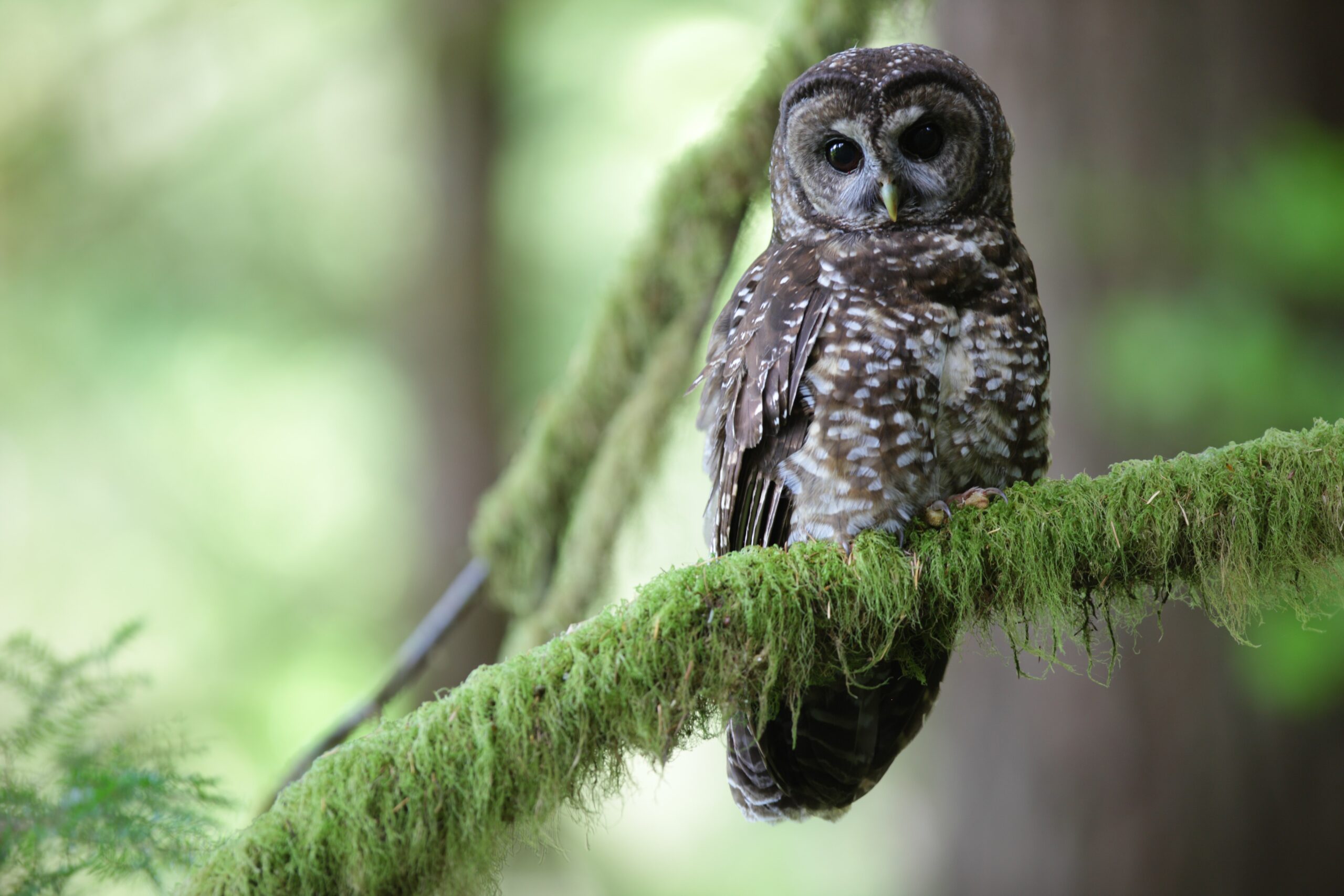
The Pacific Northwest’s ancient forests hum with secrets—whispers of wind through Douglas firs, the distant drumming of woodpeckers, and the haunting, melodic calls of the northern spotted owl. This enigmatic bird, with its dark eyes and speckled plumage, has long been a symbol of the region’s ecological soul. Yet, its future hangs in the balance, threatened by habitat loss, invasive species, and the relentless march of human progress. But amid these shadows, a flicker of hope emerges. A shift in perspective—one that embraces coexistence over domination—could rewrite the fate of this iconic species. What if the key to saving the spotted owl lies not in isolation, but in reimagining our relationship with the land itself?
The Vanishing Canopy: A Habitat in Peril
The spotted owl’s domain is the old-growth forest, a cathedral of towering conifers where sunlight barely pierces the dense canopy. These forests are not merely trees; they are living archives, their rings encoding centuries of climate shifts and ecological dramas. Yet, over the past century, industrial logging has carved through these ancient groves, reducing them to fragmented remnants. The owl’s territory, once spanning millions of acres, now clings to isolated pockets, each fragment a fragile island in a sea of clearcuts and subdivisions.
But the problem runs deeper than mere acreage. Old-growth forests are not static; they are dynamic ecosystems where dead trees stand as vital nurseries for fungi, insects, and cavity-nesting birds. When these giants fall, the entire web trembles. The spotted owl, a specialist adapted to this intricate world, struggles to adapt. Its survival hinges on the presence of large, contiguous forests—places where the understory teems with life and the canopy remains unbroken. Without these conditions, the owl’s future dims like a candle in a gale.
The Invasive Shadow: Barred Owls and the Battle for Balance
Enter the barred owl, a relative newcomer to the Pacific Northwest. Native to eastern forests, this larger, more aggressive cousin has expanded its range westward, encroaching on the spotted owl’s territory. Unlike its reclusive counterpart, the barred owl is a generalist—adaptable, vocal, and fiercely competitive. It outcompetes the spotted owl for food and nesting sites, and in some cases, even preys upon it. The result? A silent displacement, where the barred owl’s triumphs echo through the trees, and the spotted owl’s once-resonant calls grow fainter.
Conservationists face a moral quandary: should they intervene? Some argue for culling barred owls to protect the spotted owl, a controversial tactic that sparks fierce debate. Others advocate for habitat restoration, believing that a thriving old-growth ecosystem will naturally favor the native species. The truth, as always, lies somewhere in between. The barred owl is not the villain of this story—it is a symptom of a larger imbalance, a reminder that nature abhors vacuums, and when we disrupt one piece of the puzzle, another inevitably shifts to fill the gap.
The Human Equation: From Exploitation to Stewardship
To save the spotted owl, we must confront our own role in its decline. The Pacific Northwest’s forests have long been viewed as resources to be extracted, not ecosystems to be nurtured. Logging, mining, and urban sprawl have carved deep scars into the land, and the spotted owl has paid the price. But what if we redefined progress? What if, instead of seeing forests as commodities, we recognized them as lifelines—vital to clean water, carbon sequestration, and biodiversity?
This shift demands courage. It requires rethinking economic models that prioritize short-term gains over long-term sustainability. It means supporting Indigenous-led conservation, where traditional knowledge and modern science merge to heal the land. It means designing cities that coexist with nature rather than dominate it. The spotted owl’s fate is not just about saving a single species; it is about reclaiming our place within the natural world, as caretakers rather than conquerors.
The Science of Hope: Innovations in Conservation
Amid the gloom, science offers a glimmer of optimism. Researchers are exploring innovative strategies to bolster the spotted owl’s chances. Some are using drones to monitor nest sites, tracking the birds’ movements with unprecedented precision. Others are experimenting with habitat corridors—strips of restored forest that connect fragmented patches, allowing owls to disperse and thrive. Genetic studies are uncovering the owl’s adaptive potential, revealing populations that may hold the key to resilience.
Even the barred owl presents an opportunity. Some scientists argue that, rather than eradication, we should study how barred owls adapt to different forest structures. Could certain habitats deter their expansion? Could managed landscapes offer a middle ground where both species coexist? The answers are not yet clear, but the questions themselves signal a shift—a move from rigid conservation to adaptive, nuanced strategies that embrace complexity.
The Cultural Revival: Owls as Symbols of Resilience
The spotted owl is more than a biological entity; it is a cultural touchstone. For Indigenous communities, it is a guardian of sacred lands, a messenger between worlds. For artists and writers, it embodies the wild, untamed spirit of the Pacific Northwest. Its decline is not just an ecological tragedy—it is a loss of meaning, a severing of the threads that connect humans to the land.
Reviving the spotted owl’s future could be a catalyst for a broader cultural renaissance. Imagine forests where the owl’s call is once again a familiar sound, where children grow up knowing this bird not as a relic of the past, but as a living testament to nature’s endurance. Imagine policies that protect not just species, but the stories and traditions that give them life. The spotted owl’s survival could be a rallying cry for a new era of environmental stewardship—one where conservation is not a burden, but a celebration of our shared heritage.
The Path Forward: A Call to Action
The future of the spotted owl is not predetermined. It is a story still being written, one where every choice—every policy, every restored acre, every barred owl removed or spared—shapes the outcome. The challenges are immense, but so is the potential for transformation. This is not just about saving a bird; it is about redefining our relationship with the natural world.
We stand at a crossroads. Behind us lies a legacy of exploitation; ahead, a horizon of possibility. The spotted owl’s fate will be determined by whether we choose to see the forest for the trees—or, more accurately, the owl for the forest. The time to act is now. The forests are waiting. The owls are listening.