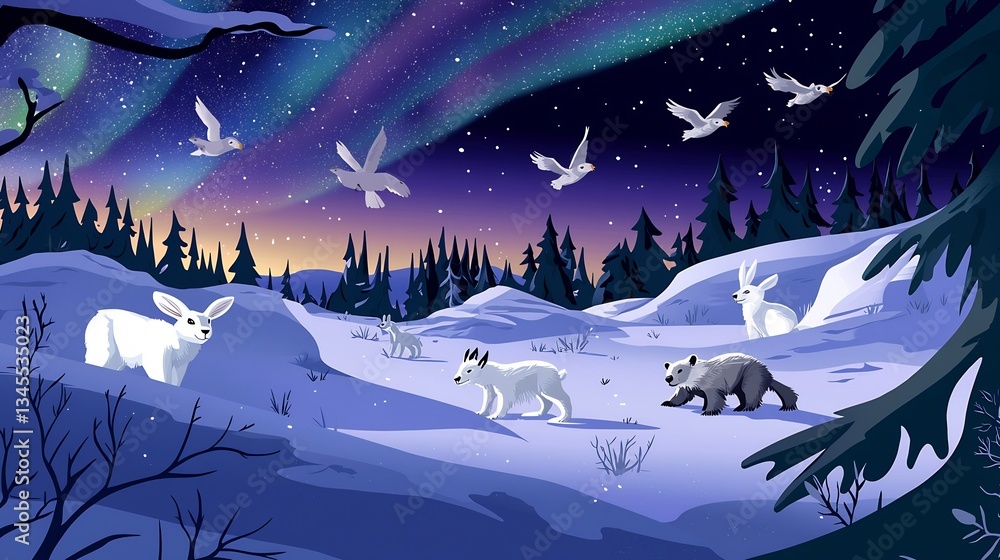
The Arctic is a realm of stark contrasts, where the silence of endless snow is punctuated by the sudden, ghostly glide of a snowy owl across the horizon. It is a landscape that demands respect, where the boundaries between predator and prey blur into something almost mythic. Yet, beyond the frozen expanse, an even more extraordinary drama unfolds—one that few witness but many marvel at: the unexpected interactions between snowy owls and polar bears. These encounters, fleeting yet charged with primal energy, reveal a hidden choreography of survival, curiosity, and the unspoken rules of the Arctic’s most formidable inhabitants.
The Arctic Stage: A Theater of Survival
The tundra is not merely a blank canvas of ice and snow; it is a stage where life performs its most desperate acts. Here, the snowy owl, a creature of ethereal beauty, rules the skies with silent wings and piercing yellow eyes. Its feathers, as white as the drifts beneath it, camouflage it against the endless whiteness, a masterstroke of evolutionary artistry. Yet, this avian sovereign shares its domain with the polar bear, a titan of the ice, whose very presence commands the landscape. The Arctic is not a place of harmony but of tense coexistence, where every interaction is a negotiation of power and survival.
When these two apex beings cross paths, the scene is set for a spectacle that transcends mere observation. The owl, perched on a hummock or a lone rock, watches with unblinking intensity as the bear ambles through the snow, its massive paws leaving deep impressions in the frozen crust. The bear, in turn, may pause, nostrils flaring as it detects the scent of prey—or perhaps the owl itself. There is no aggression in these moments, no overt hostility. Instead, there is a mutual acknowledgment, a silent understanding that this is a shared world, and each plays a role in its unending drama.

The Owl’s Watchful Eye: A Guardian of the Snows
The snowy owl is more than a hunter; it is a sentinel of the Arctic, its presence a barometer of the ecosystem’s health. With a wingspan that can stretch nearly five feet, it surveys the land with a gaze that misses nothing. Its diet, primarily lemmings, is a testament to the owl’s adaptability, but it is not above scavenging or stealing kills from other predators. Yet, when a polar bear enters its territory, the owl’s behavior shifts. It does not flee. It does not cower. Instead, it observes, sometimes even following the bear at a distance, as if studying an enigmatic neighbor.
This behavior is not mere curiosity. The owl may be assessing the bear’s movements, gauging whether the bear’s presence signals an opportunity or a threat. In the Arctic, where food is scarce and competition is fierce, such interactions are a delicate dance. The owl’s ability to read the landscape—and the creatures within it—is a survival skill honed over millennia. It is a reminder that intelligence, not just brute strength, dictates survival in this unforgiving world.
The Bear’s Silent Curiosity: A Paradox of Power
The polar bear, a symbol of raw, untamed power, is not immune to the allure of the snowy owl. Despite its reputation as a solitary hunter, the bear occasionally exhibits a rare inquisitiveness toward other creatures. When a snowy owl takes flight nearby, the bear may pause, lifting its massive head to track the bird’s trajectory. There is no chase, no attempt to dominate. Instead, there is a moment of shared existence, a fleeting connection between two of the Arctic’s most iconic species.
This curiosity is not without purpose. The bear’s keen sense of smell can detect the owl’s presence long before it is seen, and the owl’s behavior may provide clues about the whereabouts of prey. Yet, the interaction is never one-sided. The bear’s presence alone can influence the owl’s hunting patterns, forcing it to adapt its strategies to avoid becoming prey itself. In this way, the two species engage in a silent dialogue, a nonverbal exchange that speaks volumes about the intricacies of Arctic life.
The Unseen Threads: Climate and Competition
Beneath the surface of these interactions lies a deeper narrative, one shaped by the relentless march of climate change. As the Arctic warms and the ice recedes, the habitats of both snowy owls and polar bears are under siege. The owl, once a creature of the open tundra, now finds its hunting grounds shrinking, its prey dwindling. The bear, too, faces a crisis of survival, its traditional hunting grounds melting beneath its paws. In this shifting landscape, their interactions take on a new significance.
Could these encounters become more frequent as competition for resources intensifies? Will the owl, once a solitary hunter, find itself drawn into closer proximity with the bear as both species struggle to adapt? The answers are uncertain, but one thing is clear: the Arctic is no longer the stable, predictable world it once was. The interactions between snowy owls and polar bears may soon become a barometer of the region’s health, a litmus test for the resilience of its inhabitants.
The Fascination of the Unpredictable
There is a magnetic pull to these moments, a fascination that transcends the scientific. To witness a snowy owl and a polar bear in the same frame is to glimpse the raw, unfiltered essence of the Arctic—a place where survival is not guaranteed, where every interaction is a gamble, and where the boundaries between species blur into something profound. It is a reminder that nature is not a hierarchy but a web, where every thread is connected, and every creature, no matter how mighty or how small, plays a part in the grand design.
Perhaps that is why these interactions captivate us. They are not just a spectacle; they are a story. A story of adaptation, of resilience, and of the unspoken bonds that tie us all to the natural world. In the silent exchange between owl and bear, we see a reflection of our own struggles—a testament to the enduring power of life, even in the harshest of landscapes.