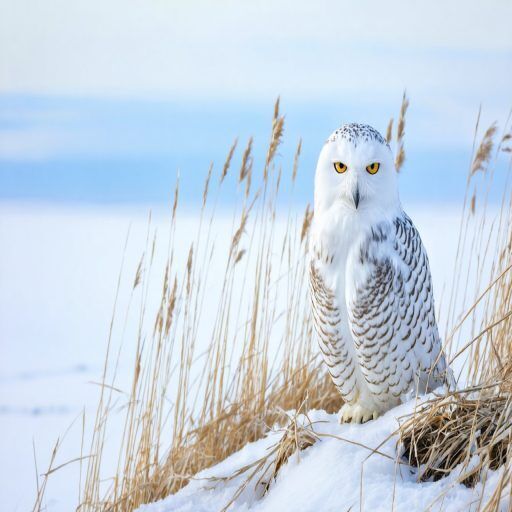
The striking white plumage of the snowy owl, punctuated only by sparse, dark markings, has long captivated observers from the Arctic tundra to the southern reaches where these enigmatic birds journey each winter. Often perceived simply as a majestic emblem of the far north, the snowy owl’s prominence extends far beyond its visual allure. This majestic raptor plays a pivotal and multifaceted role within the intricate web of Arctic biodiversity, a role that intertwines survival, adaptation, and ecological balance in ways that inspire a deeper fascination than mere aesthetic appeal. The snowy owl’s presence and behaviors offer profound insights into the health and dynamics of some of the planet’s most fragile ecosystems.
The Snowy Owl as an Apex Predator of the Tundra
At first glance, the snowy owl appears as a solitary monarch of the air, gliding silently over stark, frozen landscapes. Yet, this bird of prey is among the apex predators within its environment. Its role as a top-level predator is essential to regulating populations of small mammals, predominantly lemmings, which are keystone species in Arctic food webs. The owl’s hunting expeditions keep lemming populations in check, preventing explosive surges that could destabilize vegetative growth and indirectly disrupt numerous other species dependent on the tundra’s delicate equilibrium.
Predation by snowy owls acts as a natural check, ensuring that no single species monopolizes resources. This ecological stewardship is crucial, particularly because the Arctic tundra is characterized by extreme seasonal fluctuations that demand a finely balanced distribution of life’s necessities. Furthermore, by selectively preying on weaker or more vulnerable individuals within prey populations, snowy owls contribute to the genetic robustness and overall health of these species.
Indicator of Arctic Ecosystem Health
Beyond their predatory influence, snowy owls serve as sentinels of environmental conditions, offering a unique lens through which to observe changes in Arctic biodiversity. Their population dynamics closely mirror fluctuations in prey availability, especially the cyclical population dynamics of lemmings. When lemming populations dwindle, snowy owls either face breeding failures or wander farther afield in search of food, sometimes venturing into southern territories with unusual frequency and intensity.
This behavioral phenomenon is not merely anecdotal but a signal that researchers and ecologists use to infer shifts in the Arctic environment. As climate change accelerates and disrupts traditional ecological balances, changes in snowy owl distribution and abundance can provide early warnings of ecosystem stress. Their presence—or absence—is thus a barometer for the broader health of Arctic ecosystems.
Contribution to Nutrient Cycling
In the sparse Arctic landscape, nutrient cycling is a delicate and critical process. Snowy owls influence this cycle through their feeding and nesting behaviors. Consuming prey high in calcium and other nutrients, these birds deposit waste and organic matter at nesting sites, which in turn fertilizes soil and promotes plant growth during the brief Arctic summer.
Moreover, the remains of prey and organic residues left by snowy owls attract scavengers and decomposers, feeding a secondary layer of biodiversity that includes insects and microorganisms essential for soil health. This cascade effect underscores the owl’s integral role not just as predator but as a facilitator of biological renewal in a region where nutrient input is limited and seasonal.
Adaptations Reflecting Biodiversity Interactions
The snowy owl’s physiological and behavioral adaptations encapsulate a profound relationship with its environment and the species therein. Its thick plumage insulates against Arctic chill, enabling prolonged hunting in freezing temperatures, while its powerful talons and exceptional eyesight are finely tuned to detect prey beneath snow and ice.
These adaptations highlight an evolutionary arms race between predator and prey, where the owl must continually refine its efficiency to capture ever-elusive targets. In turn, prey species employ cryptic coloration, burrowing behavior, and reproductive timing to evade predation. This dynamic fosters biodiversity by promoting species resilience and ecological innovation.
Symbol of Cultural and Natural Heritage
The snowy owl holds profound symbolic significance for Indigenous Arctic communities, embodying wisdom, survival, and connection to the land. This cultural dimension enriches human understanding of Arctic biodiversity, inspiring conservation endeavors that honor traditional ecological knowledge alongside scientific inquiry.
By examining the snowy owl’s role through this cultural lens, a more holistic appreciation emerges—one that recognizes biodiversity not only in biological terms but as a tapestry woven with human identity, storytelling, and stewardship. The owl becomes a living bridge between nature and culture, a sentinel of both ecological and spiritual realms.
Challenges and Conservation Imperatives
Despite their formidable adaptations, snowy owls face unprecedented threats from climate change and human encroachment. Habitat degradation, shifts in prey availability, and increasing competition compromise their ability to fulfill their ecological roles effectively.
Protecting snowy owls is tantamount to preserving the broader Arctic biodiversity they help sustain. Conservation strategies must therefore integrate habitat preservation, careful monitoring of population trends, and mitigation of climate impacts. Efforts to safeguard these majestic birds resonate beyond species-level preservation; they represent commitment to maintaining the integrity of one of Earth’s last great wildernesses.
The snowy owl’s allure is undeniable—its ethereal form a beacon on the stark Arctic horizon. Yet beneath this beauty lies an indispensable actor in a complex ecological symphony. Delving deeper into its role reveals a narrative of balance, resilience, and interdependence that not only enriches our understanding of Arctic biodiversity but also humbles us with the intricate artistry of nature’s design.