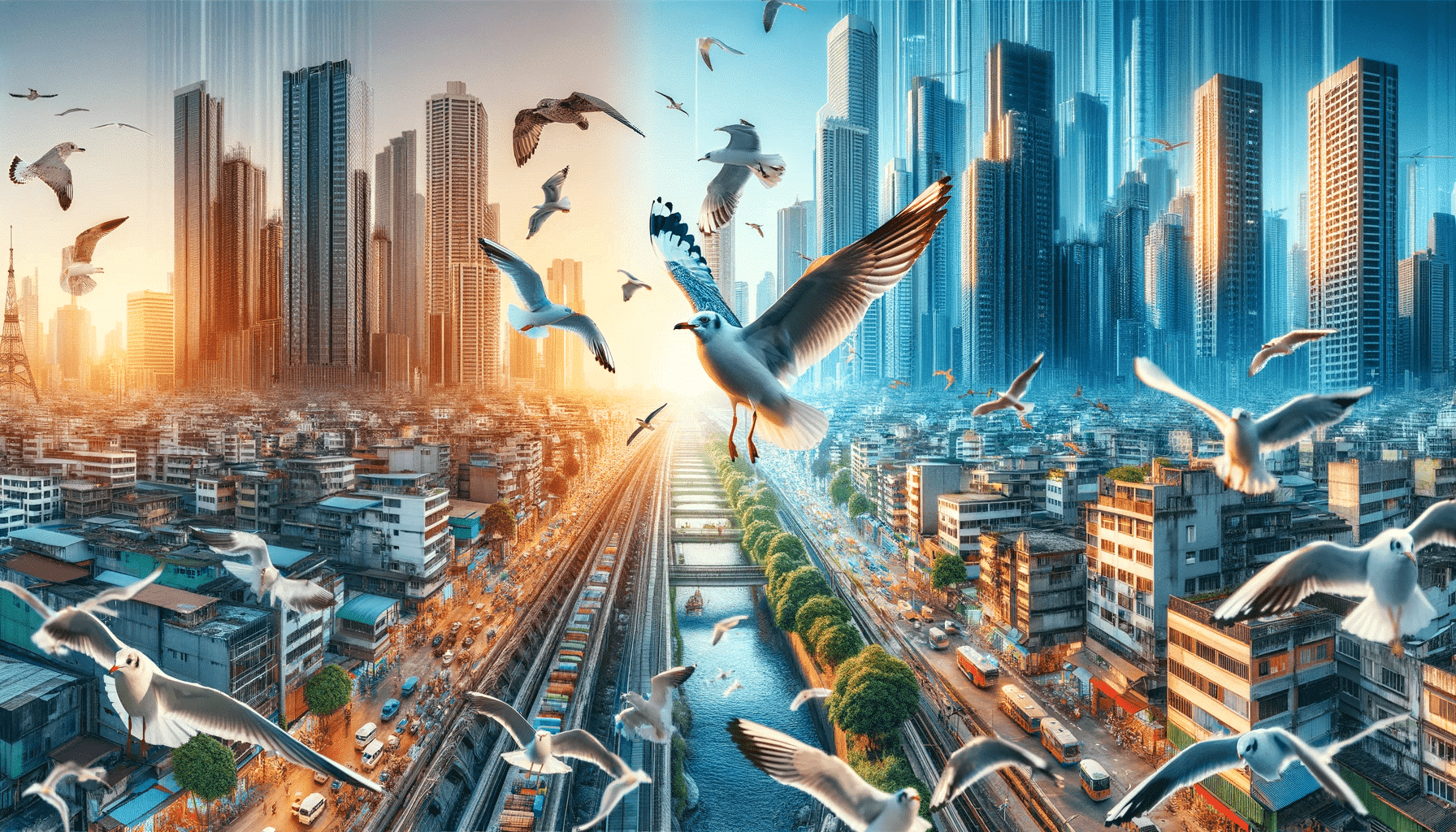
The city’s neon veins pulse with the rhythm of progress, but in the shadows of towering steel and glass, a silent exodus unfolds. Owls, those enigmatic sentinels of the night, are being unceremoniously evicted from their ancestral domains—not by force, but by the relentless march of urban sprawl. These birds of twilight, once the whispering arbiters of forest lore, now find themselves marooned in a world that no longer recognizes their language. The concrete jungle does not roar; it hums, a monotonous drone that drowns out the hoots of a species struggling to adapt. As the boundaries between wilderness and cityscape blur, we must ask: what happens when the night’s most mystical creatures are forced to abandon the night itself?
The Vanishing Canopy: How Concrete Steals the Sky
Imagine a cathedral of ancient oaks, their gnarled branches forming a vaulted ceiling where owls once ruled as silent high priests. Now, picture that cathedral replaced by a labyrinth of steel girders and asphalt arteries, where the only vaults are underground parking garages and the only ceilings are the low-hanging smog of exhaust fumes. Urban sprawl does not merely encroach upon nature—it flattens it, erases it, and replaces it with a facsimile so sterile that even the most adaptable creatures recoil. Owls, creatures of the dusk, depend on the intricate architecture of forests: the hollows of trees for nesting, the dense foliage for ambush hunting, the layered canopy for acoustic camouflage. When these vertical forests are bulldozed into horizontal parking lots, the owls lose not just their homes, but their entire existential framework.
The loss is not just spatial but sensory. A forest breathes with the rustle of leaves, the creak of branches, the distant hoot of a rival owl echoing through the dark. A city breathes with the wail of sirens, the thrum of traffic, the metallic clatter of construction. The sensory deprivation is akin to replacing a symphony with a single, ceaseless note—one that drowns out the whispers of the wild. Owls, with their hyper-acute hearing, are particularly vulnerable to this auditory erasure. Their world, once a rich tapestry of sound, becomes a cacophony of human-made noise, leaving them disoriented, stressed, and ultimately, displaced.
The Illusion of Adaptation: When the City Becomes a Trap
There is a cruel irony in the idea that some species might “adapt” to urban life. For owls, adaptation is not a triumph but a pyrrhic victory—a survival that comes at the cost of their essence. A few urban-dwelling owls may learn to nest in the eaves of buildings or hunt from the skeletal remains of dead trees repurposed as parkland, but these are not adaptations; they are desperate improvisations. The city does not offer the same sustenance as the wild. Prey becomes scarce, fragmented by roads and fences. Light pollution disorients their nocturnal rhythms, turning their once-predictable hunting grounds into a disorienting maze of glare. Even their courtship rituals, those haunting duets of hoots and screeches, are drowned out by the urban symphony.
Consider the barn owl, a ghostly specter of the night, whose pale plumage once blended seamlessly with the moonlit fields. In the city, it becomes a misfit—a creature of the dark thrust into a world that never sleeps. Studies show that urban owls often suffer from malnutrition, their diets skewed by the lack of small mammals and the abundance of human refuse. Their chicks, if they survive, grow stunted, their wings weak from the lack of open, unobstructed flight paths. The city does not nurture; it consumes, and in doing so, it reshapes life into something unrecognizable. For owls, adaptation is not evolution—it is assimilation into a world that was never meant for them.
The Ghosts of the Wild: Owls in the Age of Extinction
To speak of owls in the context of urban sprawl is to speak of ghosts—creatures that once haunted the edges of human consciousness, now fading into the periphery of memory. The great horned owl, with its piercing yellow eyes and feathered tufts like horns of a mythical beast, was once a symbol of untamed wilderness. Today, it is a relic, its haunting calls replaced by the hum of air conditioners. The snowy owl, a wanderer of the Arctic tundra, now finds itself marooned in a world of asphalt and steel, its white plumage a stark contrast to the gray monotony of the city. These are not just birds losing their homes; they are symbols of a planet losing its soul.
The extinction of habitat is not a sudden event but a slow unraveling, a thread pulled loose until the entire tapestry collapses. Owls are indicator species, their presence or absence a barometer of ecological health. When they vanish, it is not just their songs that disappear—it is the entire ecosystem they once supported. Mice, voles, and insects that owls prey upon flourish unchecked, leading to imbalances that ripple through the urban food web. The loss of owls is not an isolated tragedy; it is a canary in the coal mine, a warning of the broader collapse that urban sprawl precipitates.
The Architects of Displacement: Who Bears the Cost?
The blame for this ecological displacement does not lie with a single entity but with a collective myopia—a refusal to see the city as anything other than a machine for human consumption. Developers, governments, and urban planners operate under the delusion that nature is a resource to be exploited, not a partner to be respected. Green spaces are reduced to decorative afterthoughts, while the relentless expansion of suburbs and industrial zones gobbles up the last remnants of wilderness. Even well-intentioned initiatives, like “urban rewilding,” often fall short, creating sterile parks that lack the complexity of a true ecosystem. Owls do not thrive in manicured lawns and ornamental trees; they need the wild, the untamed, the unplanned.
The cost of this displacement is not borne by owls alone. Humans, too, suffer the consequences of a world stripped of its mysteries. Cities devoid of wildlife become sterile, soulless places where the only sounds are the clatter of keyboards and the blare of car horns. The absence of owls, those silent guardians of the night, leaves a void—a reminder that progress, unchecked, is not progress at all but a slow erasure of the world’s magic. The question we must ask ourselves is not how owls can adapt to the city, but how we can adapt our cities to the owls. The answer lies not in more concrete, but in more wilderness; not in more sprawl, but in more restraint.
The Last Hoots: A Call to Reclaim the Night
There is still time to reverse this tide, but it requires a fundamental shift in how we perceive the places we call home. Owls are not relics of a bygone era; they are living, breathing entities that deserve a place in our world. The solution is not to force them into our cities but to redesign our cities to accommodate them. This means preserving and restoring green corridors, planting native trees, and creating wildlife overpasses to connect fragmented habitats. It means reducing light pollution, limiting construction in critical habitats, and rethinking the way we build our urban landscapes. It means recognizing that the city is not the center of the universe—that wilderness is not a luxury, but a necessity.
The last hoots of the owl are not a lament but a challenge. They challenge us to see the world differently, to value the wild not as a resource to be consumed but as a heritage to be preserved. In the quiet moments between the city’s noise, when the hum of traffic fades and the stars emerge, listen closely. You might hear it—the echo of a hoot, distant but unmistakable. It is the sound of a creature fighting to survive, a reminder that even in the heart of the concrete jungle, the wild still whispers. Will we listen?