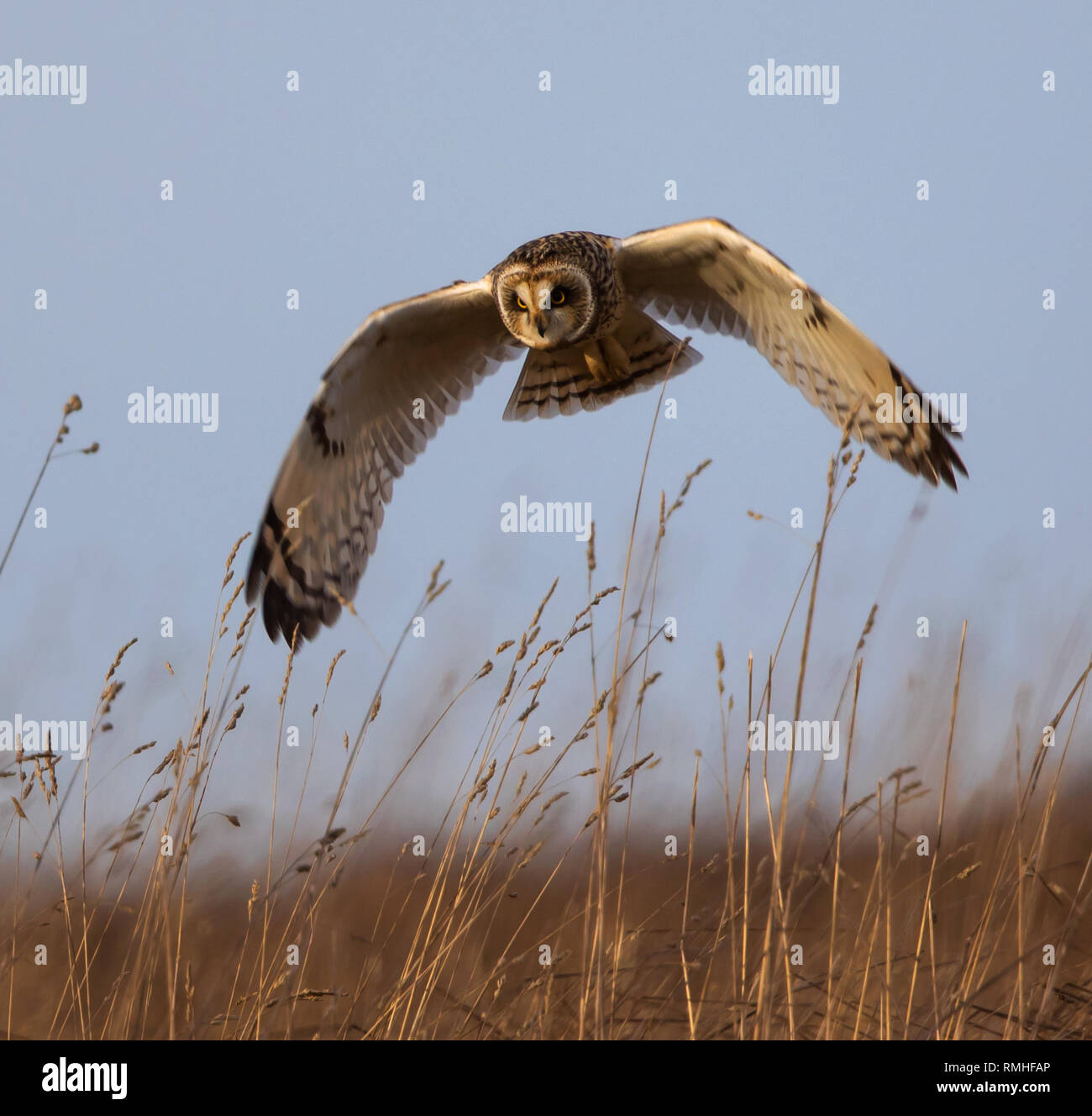
The Short-Eared Owl is a creature of paradox—a hunter cloaked in the soft hues of dusk, yet one who defies the nocturnal conventions of its kin. While most owls are the silent sentinels of moonlit forests, this enigmatic raptor takes to the skies in the diffused glow of day, a rare gem among the twilight-dwelling fraternity. Its presence is a whisper against the wind, a fleeting silhouette against the expanse of open meadows and coastal marshes. To witness it is to glimpse a fleeting moment of wild elegance, where the boundaries between day and night blur into something extraordinary.
The Day-Hunting Enigma: A Raptor Out of Sync
The Short-Eared Owl’s diurnal habits are not merely a quirk but a masterstroke of evolutionary ingenuity. Unlike its nocturnal relatives, which rely on the cloak of darkness to ambush prey, this owl thrives in the liminal hours where light and shadow dance in equilibrium. Its hunting grounds—vast, windswept grasslands and coastal dunes—are bathed in the golden hues of dawn or the muted silver of late afternoon, where the air hums with the scent of earth and grass. Here, it becomes a living paradox: a creature of the night wearing the guise of day.
This temporal dissonance is not without purpose. By hunting in daylight, the Short-Eared Owl avoids direct competition with other nocturnal predators, carving out a niche where it can dominate the skies without contention. Its prey—voles, mice, and the occasional small bird—are lulled into a false sense of security, only to be snatched from the earth in a sudden, breathtaking dive. The owl’s flight is a ballet of precision, a whirl of motion where stillness and speed collide in perfect harmony.

The Aerial Choreography: A Dance of Wind and Wing
To observe a Short-Eared Owl in flight is to witness a masterclass in aerodynamics. Its wings, broad and buoyant, cut through the air with an almost lazy grace, yet beneath that deceptive tranquility lies a powerhouse of muscle and instinct. It hovers—an act rare among owls—suspended in the sky like a kite tethered to an invisible string, its golden eyes scanning the ground below with predatory intent. When it spots its quarry, the transformation is instantaneous: a sudden, fluid descent, talons outstretched, wings folding back like the closing of a fan.
The owl’s flight is not merely functional; it is a spectacle of rhythm and motion. The deep, rhythmic wingbeats echo the pulse of the land itself, a metronome marking the passage of time in the wild. Its ability to maneuver with such agility in open terrain is a testament to its adaptability, a trait that sets it apart from the more sedentary, forest-dwelling owls. In the open expanse of a marsh or prairie, it is a creature of freedom, a transient shadow flitting across the horizon.
The Camouflage of Contrasts: A Master of Illusion
The Short-Eared Owl’s plumage is a study in subtlety and contrast. Its mottled brown and buff feathers blend seamlessly with the dried grasses and bracken of its habitat, rendering it nearly invisible until the moment it strikes. Yet, when it takes flight, its wings reveal a striking pattern of dark bars and patches, a stark contrast that serves as both warning and advertisement. This duality—of concealment and revelation—is a hallmark of its survival strategy, allowing it to remain unseen until the last possible instant.
Its face, framed by a delicate ruff of feathers, is a mask of solemnity, with eyes that gleam like molten gold in the sunlight. The facial disc, a characteristic feature of owls, funnels sound with unerring precision, allowing it to pinpoint the faintest rustle of a vole beneath the undergrowth. This silent hunter is not merely a creature of sight but of sound, a living radar dish tuned to the whispers of the wild.
The Nomadic Spirit: A Life on the Wing
Unlike many raptors that establish permanent territories, the Short-Eared Owl is a wanderer, a creature of restless motion. Its migrations are not bound by the rigid patterns of other birds but are instead dictated by the ebb and flow of prey populations. In years of abundance, it may linger in a single region, its presence a fleeting but memorable spectacle. In lean times, it takes to the skies in search of greener pastures, its journey a testament to the relentless drive of survival.
This nomadic existence is not without peril. The owl must contend with the vagaries of weather, the encroachment of human development, and the ever-present threat of predation. Yet, it persists, a living embodiment of resilience. Its ability to adapt to diverse landscapes—from the windswept moors of Scotland to the salt marshes of North America—speaks to its extraordinary versatility. It is a bird that refuses to be confined, a spirit that dances on the edge of the known world.
The Ecological Keystone: A Guardian of the Grasslands
The Short-Eared Owl is more than a hunter; it is a guardian of the ecosystems it inhabits. By preying on small mammals, it helps to regulate populations that, if left unchecked, could devastate fragile grassland habitats. Its presence is an indicator of ecological health, a living barometer of the land’s vitality. Where it thrives, the balance of nature is maintained; where it falters, the first whispers of decline may be heard.
Yet, this role is often overlooked. In an age where charismatic megafauna like wolves and eagles command attention, the Short-Eared Owl toils in relative obscurity. It is a silent sentinel, a creature of the in-between spaces, where the wild still holds sway. To champion its cause is to champion the preservation of the open landscapes it calls home—a call to action for those who recognize the value of the untrammeled world.
The Human Connection: A Fleeting Glimpse of the Wild
For those fortunate enough to encounter a Short-Eared Owl, the experience is transcendent. In a world increasingly dominated by the hum of machinery and the glow of screens, the sight of this bird in flight is a reminder of the wild’s enduring magic. It is a fleeting moment, a snapshot of a world that exists beyond the reach of human hands, yet one that we are inextricably linked to.
To witness its hunting dance is to be reminded of the beauty of the natural world, a world where predators and prey exist in a delicate equilibrium. It is a call to slow down, to look closer, to appreciate the intricate tapestry of life that unfolds beyond our doorsteps. The Short-Eared Owl is not merely a bird; it is a symbol of the wild’s resilience, a living testament to the power of adaptation and the enduring spirit of the natural world.