The Northern Spotted Owl is more than just a bird—it is a living emblem of the ancient forests that once stretched across the Pacific Northwest like a verdant cathedral. With its dark, chocolate-brown plumage speckled with white spots and eyes that gleam like molten gold, this raptor embodies the quiet majesty of old-growth ecosystems. Yet, beyond its striking appearance lies a deeper narrative: one of ecological fragility, human intervention, and the enduring struggle to preserve what remains of our planet’s most irreplaceable wild places. To encounter a Northern Spotted Owl in the wild is to witness a creature that has become a barometer of environmental health, a silent sentinel whose fate is inextricably linked to the health of the forests it calls home.
The Phantom of the Canopy: Why This Owl Captivates the Imagination
Few birds are as shrouded in mystique as the Northern Spotted Owl. Unlike its more vocal cousins, this owl is a master of stealth, its presence announced not by song but by the sudden, ghostly flutter of wings through the dense understory. Its haunting, four-note call—often likened to a distant whistle—echoes through the mist-laden groves of Douglas fir and redwood, a sound that feels less like nature’s music and more like a whispered secret from another time. This elusiveness fuels its allure. To spot one is to feel as though you’ve glimpsed a relic from an older, wilder world, a creature that has evaded the relentless march of modernity. The owl’s preference for the dim, cathedral-like interiors of old-growth forests only deepens the sense of stepping into a realm untouched by human hands. In an era where wilderness is increasingly fragmented, the Northern Spotted Owl stands as a living paradox: a symbol of both resilience and vulnerability, a creature that thrives in the shadows yet cannot escape the spotlight of conservation.
The Old-Growth Dependence: A Life Anchored in Ancient Trees
The Northern Spotted Owl is an obligate old-growth specialist, meaning its survival is inextricably tied to forests that have stood for centuries. These are not the quick-growing plantations of today but ecosystems where trees like the coast redwood, western hemlock, and Sitka spruce have weathered storms, fires, and time itself to reach towering heights. The owl’s survival hinges on three critical features of these ancient forests: large, contiguous tracts of unbroken canopy; abundant prey like flying squirrels and woodrats; and the complex, multi-layered structure that provides both nesting sites and hunting perches. When these conditions vanish—replaced by clear-cuts or young, uniform stands—the owl’s fate hangs in the balance. The irony is stark: a bird that evolved to thrive in the slow, deliberate rhythms of old growth now finds itself at the mercy of an economic system that prizes speed and efficiency over ecological integrity. The owl’s dependence on these forests is not merely a biological quirk; it is a stark reminder that some species are so finely tuned to their environment that their existence is a living testament to the health of an entire ecosystem.
The Silent Battleground: Conservation in the Face of Competing Interests
The plight of the Northern Spotted Owl is not just an ecological crisis—it is a cultural and economic one. The late 20th century saw a fierce clash between conservationists, who argued for the owl’s protection under the Endangered Species Act, and timber industries, which viewed old-growth forests as a resource to be harvested. The result was a decades-long standoff, with spotted owl populations declining as logging continued unabated in critical habitats. The owl became a flashpoint, its fate symbolizing the broader struggle to balance human needs with the imperative to preserve biodiversity. Yet, the conflict revealed deeper truths about our relationship with nature. The owl’s decline was not merely a consequence of greed or shortsightedness; it was a symptom of a worldview that treats forests as commodities rather than as living, breathing systems. Today, the battle has shifted from outright defiance to a more nuanced struggle—one that involves habitat restoration, captive breeding programs, and the painstaking work of reconciling economic demands with ecological necessity. The owl’s story is a cautionary tale, but also a call to action, reminding us that the choices we make today will reverberate through the forests—and the lives—they support for generations to come.
The Invisible Threads: How the Owl’s Fate Mirrors Ecosystem Health
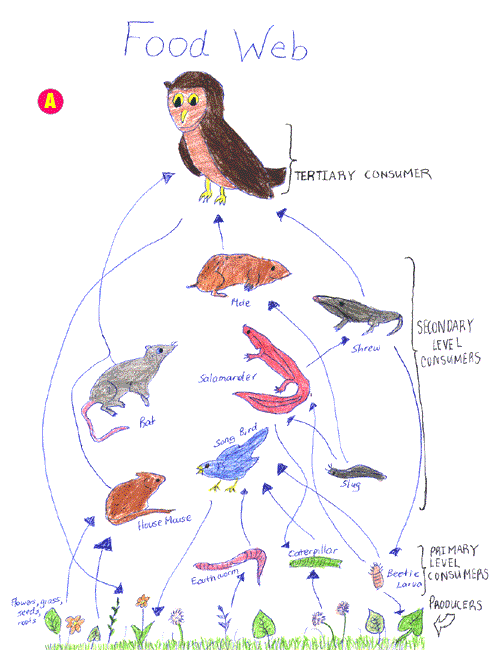
To understand the Northern Spotted Owl is to understand the intricate web of life that sustains it. This owl is not an isolated entity but a keystone species, its presence or absence sending ripples through the entire forest community. When spotted owls disappear, so too do the flying squirrels they prey upon, the woodpeckers that excavate nesting cavities, and the lichens and fungi that thrive in the moist, shaded understory. The owl’s decline is a canary in the coal mine, a warning that the forest is unraveling at its seams. Yet, its story also highlights the resilience of nature. In areas where old-growth forests have been protected, spotted owl populations have shown signs of stabilization, proving that given the chance, ecosystems can heal. This resilience is a testament to the power of conservation, but also a humbling reminder of how little we truly understand about the complex interactions that sustain life. The Northern Spotted Owl is not just a bird; it is a living barometer of the health of our planet’s most precious wild places, and its survival is a measure of our own.
The Cultural Tapestry: Why This Owl Resonates Beyond Biology
The Northern Spotted Owl has woven itself into the cultural fabric of the Pacific Northwest, appearing in Indigenous stories as a messenger between worlds and in modern literature as a symbol of wilderness under siege. Its image adorns posters, its call is sampled in ambient music, and its plight has been immortalized in documentaries and academic papers alike. This cultural resonance speaks to something primal within us—a longing for the wild, the untamed, the places where nature still holds dominion. The owl’s story is not just about conservation; it is about identity. For many who live in the shadow of the old-growth forests, the spotted owl is a totem, a reminder of what it means to belong to a place. Yet, this connection is not without tension. The owl’s protection has sometimes been framed as an obstacle to economic progress, pitting environmentalists against loggers, rural communities against urban conservationists. The challenge, then, is to find a narrative that honors both the owl’s ecological significance and the human communities that depend on the forests. The owl’s story is a mirror, reflecting our own contradictions, our own struggles to reconcile progress with preservation.
The Future in the Shadows: What Lies Ahead for the Northern Spotted Owl
The future of the Northern Spotted Owl is uncertain, but not without hope. Climate change, habitat fragmentation, and invasive species pose existential threats, yet there are glimmers of progress. Habitat restoration projects are slowly reclaiming lost ground, captive breeding programs offer a lifeline, and new technologies—like remote sensing and genetic analysis—are providing tools to better understand and protect this elusive bird. The owl’s story is far from over, and its fate will be determined by the choices we make in the coming decades. Will we continue to see the forest as a resource to be exploited, or will we recognize it as a living system that sustains us all? The Northern Spotted Owl does not ask for much—just the right to exist in the ancient groves that have been its home for millennia. In its quiet, unassuming way, it challenges us to reconsider what we value, what we protect, and what we are willing to sacrifice for the sake of a wilder, more balanced world. The owl’s call echoes through the trees, a reminder that the wild is not a place we visit, but a home we share.