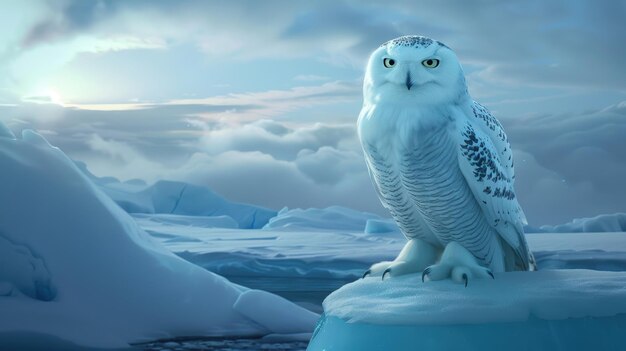
The Arctic, a realm of stark beauty and fragile balance, is undergoing a transformation that threatens its most iconic inhabitants. Among them, the snowy owl—Bubo scandiacus—stands as a silent sentinel of the tundra, its piercing yellow eyes reflecting the harsh yet magnificent landscape it calls home. Yet, beneath the shimmering expanse of ice and snow, a crisis looms. Arctic policy, once hailed as a bastion of conservation, is failing the snowy owl in ways that are as glaring as the Arctic midnight sun. This is not merely a story of environmental neglect; it’s a narrative of broken promises, misplaced priorities, and the urgent need for a radical reimagining of how we protect the Arctic’s most vulnerable species.
The Illusion of Protection: How Arctic Policy Lags Behind Reality
At first glance, the Arctic appears to be a region under the watchful eye of international agreements. Treaties like the Agreement on the Conservation of Albatrosses and Petrels or the Circumpolar Biodiversity Monitoring Program suggest a robust framework for conservation. Yet, these policies often operate in a vacuum, disconnected from the lived realities of species like the snowy owl. The owl’s habitat spans vast, remote territories where human presence is sparse, and enforcement is nearly nonexistent. Policies drafted in distant boardrooms fail to account for the nuanced, localized threats that are reshaping the Arctic landscape—threats like melting permafrost, industrial encroachment, and the cascading effects of climate change. The snowy owl, adapted to a world of ice and endurance, now faces an existential dilemma: a habitat that is literally melting beneath its talons.
Consider the Arctic Council, the preeminent intergovernmental forum for Arctic issues. While it has made strides in addressing issues like black carbon and ocean acidification, its conservation efforts often prioritize charismatic megafauna—polar bears, seals, and whales—over less “glamorous” species like the snowy owl. This bias is not just a matter of optics; it’s a failure of ecological imagination. The owl, a keystone species in its ecosystem, plays a critical role in maintaining the balance of the tundra. Its decline doesn’t just signal trouble for the owl itself; it’s a harbinger of systemic collapse. Yet, Arctic policy continues to treat the snowy owl as an afterthought, a footnote in a larger narrative dominated by more photogenic species.
The Thawing Tundra: Climate Change as the Silent Architect of Decline
Climate change is the invisible hand reshaping the Arctic, and its effects are as relentless as they are insidious. The snowy owl’s habitat is defined by the delicate interplay of ice, snow, and permafrost—a balance that is rapidly unraveling. Rising temperatures are not just melting ice; they’re altering the very fabric of the tundra, turning it into a patchwork of unstable terrain. For the snowy owl, which relies on the open, windswept plains of the Arctic for hunting, this transformation is catastrophic. Shrubification—the encroachment of woody plants into previously barren landscapes—is reducing the open spaces the owl depends on. Meanwhile, the melting of permafrost is causing the ground to collapse, creating sinkholes that disrupt nesting sites and foraging grounds.
But the impacts of climate change extend beyond the physical landscape. The snowy owl’s prey base is also in flux. Lemmings, the owl’s primary food source, are declining as their own habitats shrink and their reproductive cycles are disrupted by erratic weather patterns. A single snowy owl may consume over 1,500 lemmings in a year, but as lemming populations dwindle, the owl is forced to compete with other predators or starve. This trophic cascade is a stark reminder that the Arctic is not a static ecosystem but a dynamic, interconnected web—and the snowy owl is one of its most vulnerable threads. Yet, Arctic policy remains woefully inadequate in addressing these cascading effects. Climate adaptation strategies are often piecemeal, focusing on mitigation rather than the urgent need for resilience in species like the snowy owl.
Industrial Intrusion: The Unseen Scars on the Arctic Landscape
The Arctic is not just a victim of climate change; it is also a target for industrial exploitation. Oil and gas drilling, mining, and shipping routes are carving deep scars into the tundra, fragmenting habitats and introducing pollutants that linger in an ecosystem ill-equipped to handle them. The snowy owl, with its vast home range, is particularly vulnerable to these disruptions. Oil spills, even minor ones, can contaminate water sources and prey species, while the noise and disturbance from industrial activities can displace owls from their nesting sites. The Arctic’s remoteness does not shield it from these threats; it merely delays their consequences.
Consider the Northern Sea Route, a shipping lane that is becoming increasingly viable as ice melts. The surge in maritime traffic brings with it the risk of oil spills, underwater noise pollution, and the introduction of invasive species—all of which threaten the snowy owl’s habitat. Yet, Arctic policy has been slow to regulate these activities or to enforce existing protections. The International Maritime Organization’s Polar Code, while a step in the right direction, lacks the teeth to address the specific vulnerabilities of species like the snowy owl. Meanwhile, indigenous communities, who have coexisted with the snowy owl for generations, are often sidelined in decision-making processes, their traditional knowledge ignored in favor of top-down industrial agendas.
The Policy Paradox: Why Conservation Efforts Fall Short
At the heart of the snowy owl’s plight lies a paradox: despite the existence of robust conservation policies, their implementation is riddled with gaps, contradictions, and outright failures. The Convention on Biological Diversity and the IUCN Red List classify the snowy owl as a species of least concern, a designation that belies its declining populations in key regions. This misclassification stems from a lack of comprehensive, long-term data—a gap that Arctic policy has done little to address. Without accurate population estimates or habitat assessments, conservation efforts are flying blind, reacting to crises rather than preventing them.
Moreover, Arctic policy is often hamstrung by political inertia. The Arctic Council, for all its diplomatic achievements, operates on consensus, meaning that even well-intentioned proposals can be watered down or blocked by member states with conflicting interests. The result is a patchwork of weak commitments and non-binding agreements that do little to address the urgency of the snowy owl’s decline. Meanwhile, funding for Arctic conservation is woefully inadequate, with a disproportionate amount directed toward high-profile species or short-term projects rather than the long-term, ecosystem-wide strategies that the snowy owl desperately needs.
A Call to Action: Redefining Arctic Policy for the Snowy Owl’s Future
The failure of Arctic policy to protect the snowy owl is not just an environmental issue; it’s a moral one. The owl, with its silent grace and unyielding spirit, is a symbol of the Arctic’s resilience—and its fragility. To reverse its decline, we must rethink conservation from the ground up. This means prioritizing species like the snowy owl in policy discussions, investing in long-term ecological research, and centering the voices of indigenous communities who have stewarded these lands for millennia. It means holding industrial actors accountable for their role in habitat destruction and demanding that climate adaptation strategies account for the cascading effects of a warming Arctic.
But most importantly, it means recognizing that the snowy owl is not just a species to be saved—it is a bellwether of the Arctic’s health, a living testament to the consequences of our collective inaction. The policies we craft today will determine whether the snowy owl’s haunting call continues to echo across the tundra or fades into silence. The choice is ours. Will we continue to let Arctic policy fail the species that call it home, or will we rise to the challenge and redefine what it means to protect the Arctic’s wild heart?