The Pacific Northwest’s ancient forests, where mist clings to towering Douglas firs and the air hums with the whispers of unseen creatures, are undergoing a transformation as fierce and relentless as the wildfires that now scar their landscapes. Among the most affected is the northern spotted owl, a bird whose very existence has become a battleground for conservation, politics, and the unyielding march of climate change. Once a symbol of old-growth resilience, this elusive raptor now faces a future reshaped not just by human hands, but by the very flames that once shaped these forests in cycles of renewal. What does this mean for the owl, for the forests, and for those who have fought to protect them? The answers lie not in the ashes, but in the stories they tell.
The Spotted Owl: A Relic of the Ancient Canopy
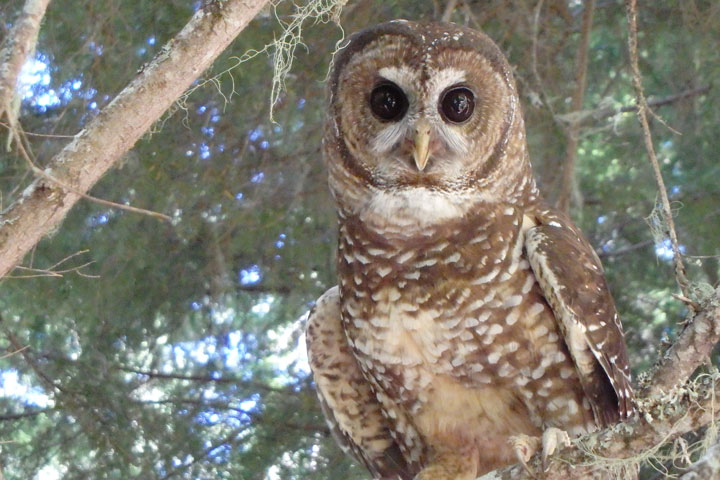
The northern spotted owl (*Strix occidentalis caurina*) is more than a bird—it is a living relic, a creature of dusk and dense foliage, whose survival is inextricably tied to the towering conifers of the Pacific Northwest. These owls, with their dark, mottled plumage and haunting calls, once thrived in the cathedral-like expanse of old-growth forests, where the canopy was so thick that sunlight barely pierced the gloom below. Their nests, often reused for generations, were cradled in the hollows of ancient trees, some over 500 years old. But as the forests have been logged, fragmented, and now scorched, the owl’s domain has shrunk to a fraction of its former glory.
What makes the spotted owl so vulnerable is not just its dependence on old-growth trees, but its inability to adapt. Unlike their more opportunistic cousins, these owls are specialists, thriving only in the cool, moist microclimates of undisturbed forests. When wildfires roar through, they don’t just destroy nesting sites—they alter the very fabric of the ecosystem. The owl’s prey, from flying squirrels to wood rats, disperses or perishes. The understory, once a tangled web of ferns and shrubs, becomes a charnel house of ash and embers. For a species already teetering on the edge, the fires are not just a threat—they are a reckoning.
Fire’s Dual Role: Destruction and Rebirth
Wildfires are not inherently malevolent. In the Pacific Northwest, fire has always been a natural force, a sculptor of landscapes that has shaped these forests for millennia. Low-intensity fires, long suppressed by human intervention, would creep through the understory, clearing away deadwood and invigorating the soil. But decades of fire suppression, combined with a warming climate, have turned these once-benign flames into infernos that consume everything in their path. The result is a paradox: fire, which once maintained the owl’s habitat, now threatens to erase it entirely.
Consider the aftermath of a severe wildfire. The forest floor, once a vibrant tapestry of life, is now a moonscape of blackened stumps and skeletal trees. Yet, even in this devastation, life stirs. Fire-adapted species like the lodgepole pine and Douglas fir begin to regenerate, their cones bursting open in the heat to release seeds long dormant. But for the spotted owl, the window for recovery is narrow. The owl’s survival hinges on the presence of large, contiguous patches of old-growth forest—precisely the kind of habitat that is most vulnerable to high-severity fires. As these patches shrink, the owl’s territory fractures, leaving isolated populations vulnerable to inbreeding and local extinction.
The Climate Crucible: When Fire Meets Drought
The Pacific Northwest is no stranger to fire, but the fires of today are different. They are hotter, faster, and more unpredictable, fueled by a climate that has grown increasingly volatile. Droughts, once rare in these temperate rainforests, now linger like unwelcome guests, parching the land and turning it into tinder. The result is a perfect storm: a landscape primed for ignition, where even a single spark can ignite a catastrophe.
For the spotted owl, this means that the fires are not just changing their habitat—they are accelerating its demise. In the past, owls could potentially relocate to unburned areas, but as fires grow larger and more frequent, these refuges are disappearing. The owl’s range, already constricted by logging and urban sprawl, is now being carved up by flames. Some studies suggest that in the most fire-prone regions, spotted owl populations could decline by as much as 50% over the next few decades. The question is no longer whether the owl can adapt, but whether it can survive long enough to do so.
Human Hands in the Flames: Logging, Policy, and the Owl’s Plight
To blame wildfires solely on climate change is to ignore the role that human hands have played in shaping this crisis. Decades of aggressive logging, particularly in the owl’s core habitat, have left the forest fragmented and vulnerable. Clear-cutting and selective logging remove the largest, most fire-resistant trees, leaving behind a landscape that is not only less resilient to fire but also less capable of supporting the owl’s complex ecological needs. When fires do strike, these altered forests burn hotter and faster, turning what might have been a manageable blaze into an unstoppable force.
Policy, too, has played a contradictory role. While conservation efforts have sought to protect the owl’s habitat, economic pressures have often overridden these protections. Timber industries, driven by short-term gains, have pushed for logging in areas critical to the owl’s survival. Meanwhile, fire management strategies have oscillated between suppression and controlled burns, neither of which has adequately addressed the owl’s needs. The result is a landscape caught in a tug-of-war between exploitation and preservation, where the owl is the rope—and the fraying end.
The Silent Exodus: Where Do the Owls Go?
As the forests burn, the spotted owl’s options are dwindling. Some may flee to higher elevations, where cooler temperatures and moister conditions offer a reprieve from the flames. Others may seek refuge in the few remaining old-growth strongholds, but these areas are increasingly isolated, making it difficult for owls to find mates or establish new territories. The owl’s low reproductive rate—a female may lay only one or two eggs every two years—further compounds the challenge. In a landscape where every tree could be the last, the owl’s future is one of precarious choices and uncertain outcomes.
Yet, there are glimmers of hope. In some areas, post-fire landscapes are beginning to regenerate, and with careful management, these young forests could one day support the owl again. Conservationists are experimenting with techniques like prescribed burns and selective thinning to reduce fire severity and create firebreaks that protect critical habitat. But these efforts are piecemeal, often underfunded, and frequently stymied by political and economic interests. The owl’s survival will require more than just good intentions—it will demand a fundamental rethinking of how we coexist with fire, with forests, and with the creatures that call them home.
The Owl’s Call: A Warning for Us All
The northern spotted owl is not just a bird—it is a sentinel, a living barometer of the health of the Pacific Northwest’s forests. Its decline is not an isolated tragedy; it is a symptom of a larger crisis, one that threatens not only biodiversity but the very ecosystems that sustain human life. As the fires rage and the forests burn, the owl’s story is a reminder that we are not separate from nature. We are part of it, and our actions—whether through climate change, logging, or policy—have consequences that ripple through the web of life.
What happens to the spotted owl will shape the future of these forests. Will we let them become a wasteland of ashes and silence, or will we choose to listen—to the owl’s call, to the whispers of the forest, and to the urgent need for change? The choice is ours, but the time to act is now.