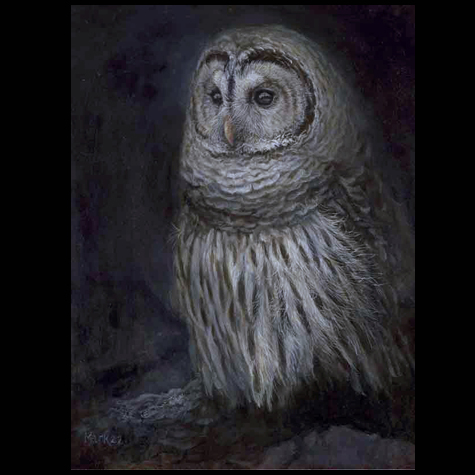
There’s a silent usurper in the night, a feathered sovereign whose haunting calls echo through ancient woodlands like a whispered secret. The barred owl, with its soulful eyes and striped plumage, has long been a creature of mystery—until now. Once confined to the dense forests of the East, this enigmatic bird has begun an audacious expansion, rewriting the rules of the natural world. But is this shift a triumph of adaptability or a harbinger of ecological upheaval? The barred owl’s story is one of quiet rebellion, a tale of survival that forces us to question what we think we know about wilderness and dominance.
The Barred Owl’s Unassuming Rise to Power
For centuries, the barred owl thrived in the shadowy embrace of old-growth forests, its presence a whisper in the canopy. Its name—*Strix varia*—hints at its variegated plumage, a tapestry of browns and whites that camouflages it against the bark of ancient trees. But this unassuming bird harbored a secret: an unshakable resilience, a cunning adaptability that would soon catapult it into new territories. As human landscapes expanded, so too did the barred owl’s ambitions. It ventured westward, its hoots—once a symphony of the East—now resonating in the Pacific Northwest, a region it had never before called home.
The owl’s migration wasn’t a mere stumble into the unknown; it was a calculated conquest. Unlike migratory birds bound by seasonal rhythms, the barred owl moved with deliberate purpose, its territory expanding by miles each year. Ecologists watched in awe as this once-reclusive species claimed new hunting grounds, its diet diversifying from the familiar rodents of the East to the unsuspecting prey of the West. Squirrels, rabbits, even other birds—none were safe from its silent, feathered gaze. The barred owl wasn’t just surviving; it was thriving, rewriting the ecological playbook as it went.
The Controversy: A Silent Ecological Coup
Yet, not everyone cheers this feathered pioneer. The barred owl’s westward expansion has ignited a firestorm of debate, pitting conservationists against conservationists in a clash of ideals. To some, the owl is a symbol of nature’s relentless adaptability—a testament to life’s ability to reclaim and reinvent. To others, it’s an invasive force, a disruptor of delicate balances that took millennia to establish. The northern spotted owl, a reclusive denizen of the Pacific Northwest’s ancient forests, finds itself in the barred owl’s crosshairs. Once the undisputed monarch of these woodlands, the spotted owl now faces a rival it never anticipated—a rival that may outcompete it for food, territory, and even mates.
The controversy deepens when we consider the barred owl’s impact on biodiversity. Its presence alters the behavior of smaller birds, driving them from their nests or forcing them into less optimal habitats. Predators that once relied on a stable prey base now find their food sources diminished. The owl’s arrival isn’t just a local disturbance; it’s a ripple effect, a cascade of consequences that reverberates through the ecosystem. Some argue that the barred owl’s expansion is a natural phenomenon, a response to climate change and habitat alteration. Others see it as a cautionary tale, a reminder that even the most benign-seeming creatures can become agents of upheaval when the rules of the game change.
The Barred Owl’s Arsenal: Why It’s Winning the Survival Game
What makes the barred owl such a formidable force? The answer lies in its extraordinary adaptability. Unlike many species that cling to specific habitats or diets, the barred owl is a generalist—a master of versatility. It thrives in forests, wetlands, and even suburban parks, its diet as varied as its terrain. It preys on everything from voles to songbirds, its hunting prowess unmatched in the avian world. Its call, a haunting *”Who cooks for you? Who cooks for you-all?”*, is both a territorial declaration and a hunting lure, a dual-purpose serenade that lures prey into its grasp.
But the barred owl’s greatest weapon may be its intelligence. Studies suggest that it possesses a keen problem-solving ability, a trait that allows it to exploit new food sources and outmaneuver competitors. It’s not just a predator; it’s a strategist, a creature that learns and adapts with each passing season. This cognitive flexibility gives it an edge in an ever-changing world, where the old rules no longer apply. The barred owl doesn’t just survive—it dominates, its presence reshaping the very fabric of the ecosystems it invades.
The Ethical Dilemma: Should We Intervene?
The barred owl’s story forces us to confront an uncomfortable question: When does conservation become interference? The northern spotted owl’s decline has prompted drastic measures, including the controversial culling of barred owls to protect its dwindling population. But is this ethical? Is it justifiable to sacrifice one species to save another, even if the latter is an invader? The debate rages on, with no clear answers. Some argue that nature should be allowed to run its course, that the barred owl’s expansion is a natural response to environmental change. Others believe that human intervention is necessary to preserve the delicate balance of the Pacific Northwest’s forests.
This dilemma extends beyond the barred owl. It forces us to reconsider our role in the natural world. Are we stewards of the earth, or are we merely observers, powerless to dictate the course of evolution? The barred owl’s story is a mirror, reflecting our own uncertainties about control, dominance, and the limits of conservation. It challenges us to think deeply about what we value in nature and whether our interventions are driven by science or sentiment.
The Barred Owl’s Legacy: A New Chapter in Nature’s Story
The barred owl’s journey is far from over. As it continues its silent march across the continent, it leaves behind a trail of questions and contradictions. Is it a hero, a villain, or merely a player in a much larger game? One thing is certain: its story is rewriting the narrative of wildlife in North America. It’s a tale of resilience, adaptability, and the unpredictable nature of life itself. The barred owl doesn’t just challenge the status quo; it obliterates it, forcing us to see the world through new eyes.
Perhaps the greatest lesson of the barred owl is this: nature is not static. It is a dynamic, ever-shifting tapestry, and the creatures within it are not bound by the rules of the past. The barred owl’s expansion is a reminder that dominance is not a birthright but a fleeting privilege, one that can be seized by the most unlikely of contenders. In a world where change is the only constant, the barred owl stands as a symbol of nature’s relentless, unapologetic evolution. And whether we like it or not, its story is our story too—a story of survival, adaptation, and the quiet revolutions that shape our world.