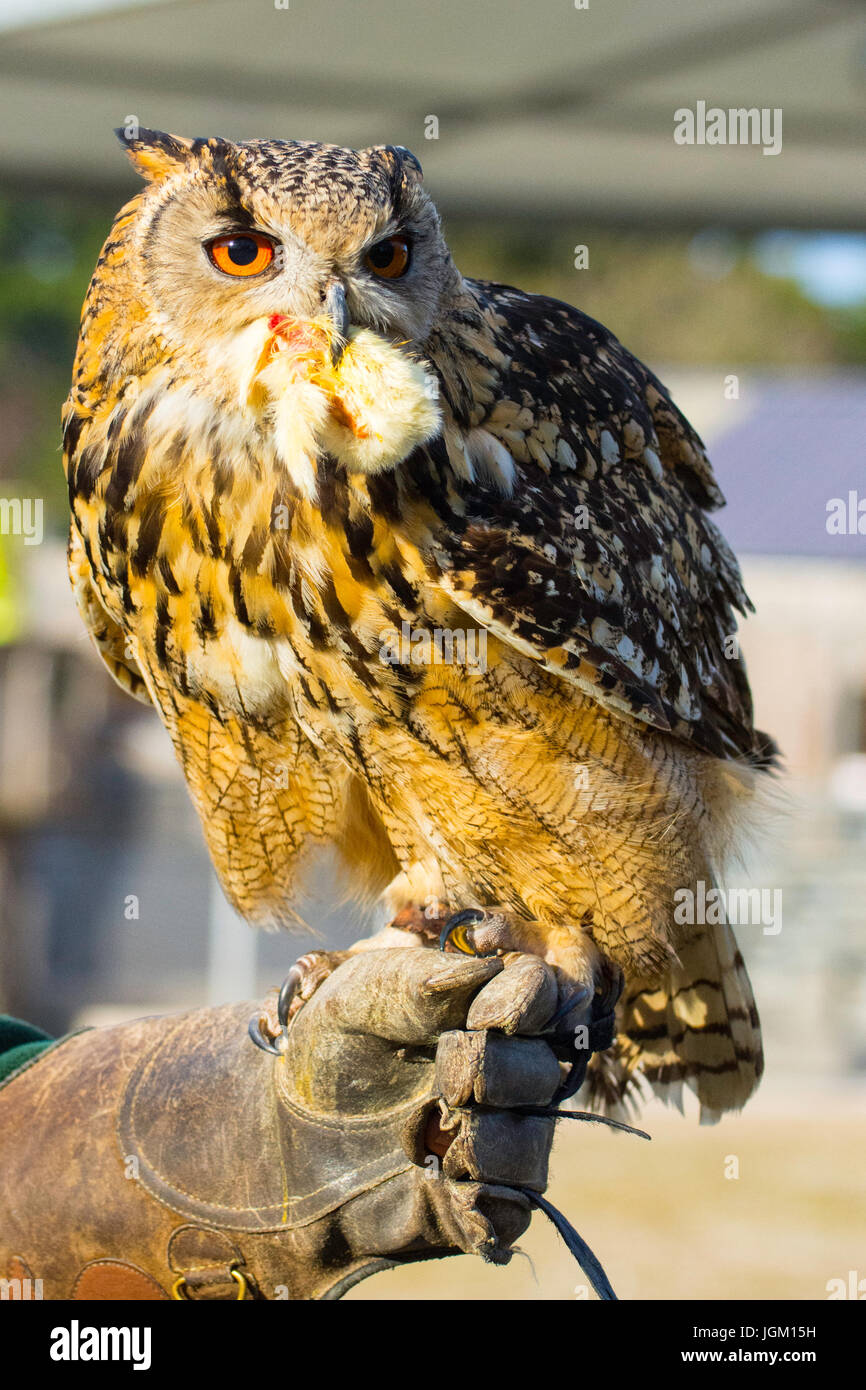
What if the silent sentinels of Europe’s ancient forests, the eagle owls, were not just passive observers of ecological change—but the architects of it? These nocturnal titans, with their piercing gaze and formidable talons, wield an influence that ripples through the very fabric of forest dynamics. From the mist-shrouded beech groves of Germany to the rugged crags of the Carpathians, Bubo bubo is rewriting the rules of woodland life. But how? And at what cost?
The Silent Predator’s Paradox: A Keystone in Disguise
Eagle owls are not mere predators; they are ecological engineers. Their presence alone can send tremors through the food web, reshaping the behavior of prey species in ways that cascade through entire ecosystems. Consider the humble European hare, a staple in their diet. When eagle owls establish territory, hares alter their grazing patterns, favoring dense thickets over open meadows—a shift that, over time, can transform understory composition. The forest floor, once a patchwork of grasses and wildflowers, becomes a labyrinth of woody shrubs, altering light penetration and soil moisture. This isn’t just a dietary adjustment; it’s a silent revolution in forest structure.
But the paradox deepens. Eagle owls don’t just hunt—they intimidate. Their mere vocalizations, a haunting duet of deep hoots echoing through the night, can deter smaller predators like foxes and martens. This “landscape of fear” doesn’t just protect their prey; it reshapes the distribution of mesopredators, allowing ground-nesting birds and rodents to reclaim niches they might otherwise avoid. The forest, in turn, becomes a stage for a delicate balance of fear and opportunity.
The Talon’s Touch: How Hunting Reshapes Forest Biodiversity
The eagle owl’s hunting prowess is legendary, but its impact extends far beyond the immediate kill. Their diet—ranging from voles to young deer—means they are selective agents of mortality, culling the weak and the young. This isn’t indiscriminate predation; it’s a form of natural selection that can strengthen prey populations over generations. Take the wild boar, a species whose burgeoning numbers have become a thorn in the side of European foresters. Eagle owls, though not primary boar hunters, will target piglets, subtly thinning herds and reducing rooting damage to saplings. The result? A forest floor that regenerates more successfully, with young trees spared the trampling fate of their overgrazed counterparts.
Yet, this boon comes with a caveat. Eagle owls are opportunists. When other prey becomes scarce, they turn to species already under pressure, such as ground-nesting birds like the capercaillie. In regions where eagle owl populations have surged, ornithologists have documented declines in these iconic birds, their nests raided under the cover of night. The forest, then, faces a cruel irony: the very predator that sustains its structure may also erode its song.
The Night’s Shadow: Eagle Owls and the Nocturnal Food Web
Europe’s forests are not just daytime kingdoms. As dusk falls, a parallel world awakens—one where eagle owls reign supreme. Their nocturnal dominance disrupts the delicate balance of night-active species. Bats, for instance, alter their flight paths to avoid owl territories, reducing their foraging efficiency in certain areas. Meanwhile, owls themselves become prey to larger raptors like golden eagles, creating a hidden arms race in the treetops. The forest’s nocturnal food web is a tangle of adaptations, where every species must dance around the eagle owl’s shadow.
But what happens when this shadow grows too long? In some regions, eagle owl populations have exploded due to habitat expansion and reduced persecution. The consequences are stark. In Spain’s dehesa landscapes, where eagle owls share space with declining vultures, their presence has been linked to reduced scavenging opportunities for these scavengers. The forest, it seems, can only sustain so many apex players.
The Future of the Forest: Can Eagle Owls Be Both Savior and Scourge?
The eagle owl’s role in European forests is a study in contradictions. They are guardians of biodiversity in some realms, architects of decline in others. Their influence is a reminder that nature’s balance is not static but a shifting mosaic of cause and effect. Yet, this duality poses a challenge: How do we manage a species whose very presence can tip the scales in unpredictable ways?
Conservationists grapple with this dilemma. In areas where eagle owl populations are expanding, should we intervene to protect vulnerable species? Or is their rise a natural correction, a return to a pre-human equilibrium where apex predators once ruled unchallenged? The answer may lie not in control, but in coexistence. Perhaps the key is to ensure that Europe’s forests retain enough heterogeneity—diverse habitats, ample prey, and space for all species—to absorb the eagle owl’s influence without collapse.
So, we return to our original question: Are eagle owls the unseen sculptors of Europe’s forests, or are they the harbingers of an ecological imbalance? The truth, as ever, is more nuanced. They are both. And in that duality lies the lesson: that nature’s most powerful forces are not those that dominate, but those that remind us of the delicate threads that bind an ecosystem together.