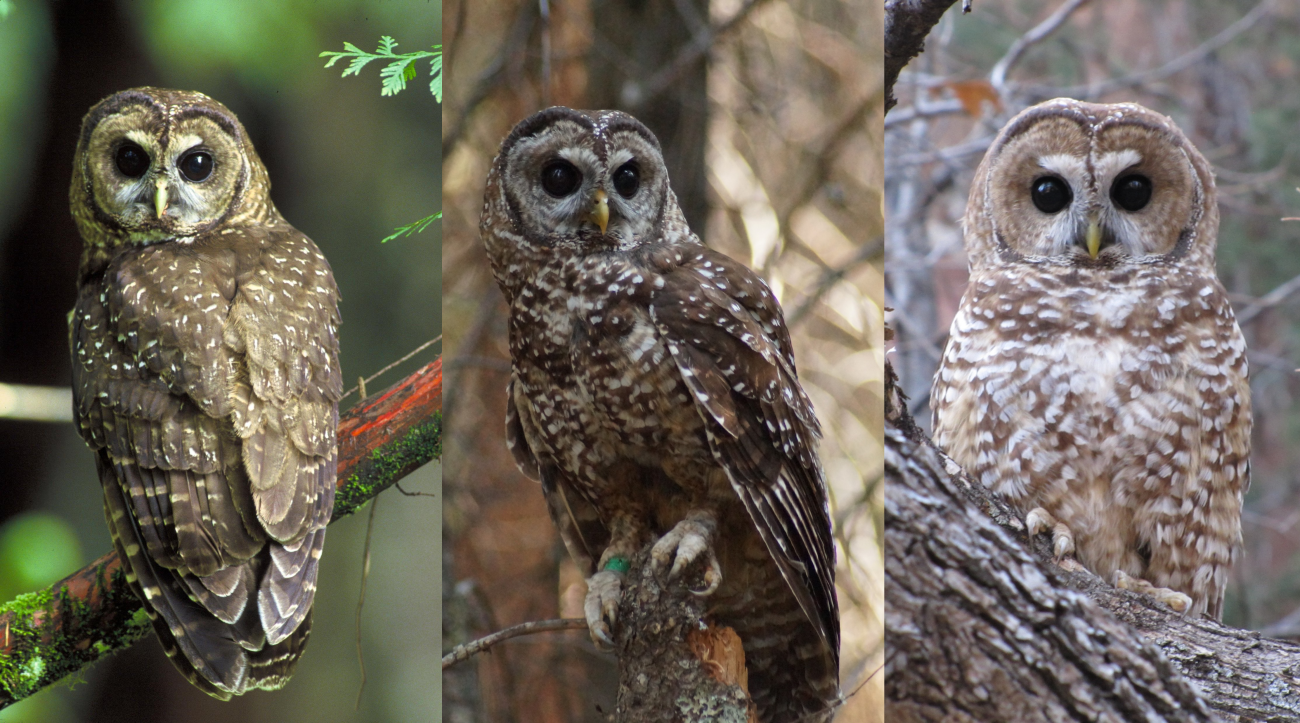
The California spotted owl (Strix occidentalis occidentalis) is not merely a bird—it is a living emblem of the ancient forests it calls home. With its speckled plumage and haunting calls echoing through the towering redwoods and mixed conifer woodlands, this subspecies has long captivated both scientists and casual observers alike. Yet beneath its enigmatic gaze lies a story far more intricate than the simple beauty of its appearance. What draws us to this owl is not just its striking features, but the deeper mysteries it embodies—questions of survival, adaptation, and the delicate balance between human progress and ecological preservation.
The Silent Guardian of the Canopy
Perched high among the gnarled branches of old-growth forests, the California spotted owl moves with a quiet grace that belies its fierce predatory nature. Unlike its more vocal relatives, this owl often remains unseen, its presence betrayed only by the soft rustle of wings or the occasional low, resonant hoot that resonates through the mist-laden air. Its mottled brown and white feathers blend seamlessly with the dappled sunlight filtering through the canopy, a masterclass in natural camouflage. Yet this stealth is not merely for concealment—it is a survival tactic honed over millennia, a silent pact between predator and prey in an ecosystem where every advantage counts.
The owl’s habitat preference for dense, multi-layered forests is no accident. These ancient woodlands, with their towering conifers and understory thickets, provide not just shelter but also a rich hunting ground teeming with woodrats, squirrels, and other small mammals. The owl’s diet is a testament to its adaptability, shifting with the seasons and the availability of prey. In winter, when snow blankets the forest floor, it may rely more heavily on arboreal rodents, while in summer, it can exploit the abundance of fledglings and insects. This dietary flexibility is a subtle yet profound indicator of the owl’s resilience—a trait that has allowed it to endure where others might falter.
The Invisible Threads of an Ecosystem
To understand the California spotted owl is to peer into the intricate web of relationships that sustain its world. This owl is not an isolated entity but a keystone species, its presence influencing the very structure of the forest. Studies have shown that where spotted owls thrive, the forest ecosystem flourishes in tandem. Their nesting habits, often in the hollows of ancient trees or on sturdy branches, create opportunities for other cavity-nesting birds and mammals. The owl’s territorial calls may even regulate the behavior of smaller predators, preventing overpopulation and maintaining ecological equilibrium.
Yet this balance is precarious. The owl’s reliance on old-growth forests makes it particularly vulnerable to habitat fragmentation—a consequence of logging, urban expansion, and climate change. As these forests shrink, so too does the owl’s domain, forcing it into smaller, isolated pockets of wilderness. The irony is stark: a species that has survived for millennia now faces existential threats from the very creatures that share its habitat. The owl’s struggle is a microcosm of a larger crisis, one where the relentless march of human development clashes with the silent, enduring rhythms of nature.
The Enigma of the Owl’s Call
Few sounds in the natural world are as evocative as the call of the California spotted owl. A series of deep, resonant hoots that rise and fall like a slow, mournful melody, it is a sound that stirs something primal within us. To hear it is to be transported to a time when such calls echoed unchallenged across vast, untouched landscapes. Yet the owl’s vocalizations are more than just a haunting melody—they are a language, a means of communication that reveals much about its social structure and territorial behavior.
Males are particularly vocal during the breeding season, their calls serving as both a declaration of territory and a serenade to potential mates. The frequency and pattern of these calls can convey information about the owl’s health, age, and even its intentions. A strong, clear hoot may signal dominance and fitness, while a weaker or erratic call could indicate stress or competition. This vocal complexity adds another layer to the owl’s mystique, hinting at a social intelligence that is often overlooked in favor of its physical prowess. It is a reminder that this bird is not just a silent observer but an active participant in the intricate dance of forest life.
The Shadow of Extinction
Despite its resilience, the California spotted owl faces an uncertain future. The U.S. Fish and Wildlife Service has listed it as a species of concern, and conservation efforts are underway to protect its dwindling habitat. Yet the challenges are formidable. Wildfires, exacerbated by climate change, have scorched vast swaths of forest, while droughts and insect infestations weaken the remaining woodlands. The owl’s slow reproductive rate—females typically lay only one to three eggs per year—further compounds the difficulty of recovery.
The debate over how to best conserve the owl has sparked contentious discussions among policymakers, scientists, and environmentalists. Some advocate for strict protections of old-growth forests, while others argue for managed logging practices that could balance economic interests with ecological needs. The owl, caught in the crossfire of these competing priorities, becomes a symbol of the broader struggle to reconcile human ambition with environmental stewardship. Its fate is a litmus test for our ability to coexist with the natural world—a test we are failing, but one that is not yet beyond redemption.
A Symbol of What We Stand to Lose
There is a peculiar fascination with the California spotted owl, one that transcends its physical beauty. It is the fascination of a creature that embodies both the fragility and the tenacity of life. To lose this owl would be to lose more than a species—it would be to lose a piece of the ancient soul of the forest, a living testament to the resilience of nature in the face of adversity. It would be to acknowledge that we have failed to heed the warnings written in the silent wings of the owl, in the fading echoes of its call.
Yet there is hope. Conservation initiatives, habitat restoration projects, and public awareness campaigns are slowly gaining traction. Communities are coming together to protect the forests that sustain the owl, recognizing that its survival is intertwined with their own. The California spotted owl, with its piercing gaze and haunting calls, serves as a poignant reminder of what we stand to lose if we continue to turn a blind eye to the consequences of our actions. It is a call to action—not just for the owl, but for the forests, the rivers, and the countless other species that depend on the delicate balance of life.
In the end, the California spotted owl is more than a subspecies on the edge. It is a mirror, reflecting our own choices and their consequences. To save it is to save a part of ourselves—a part that remembers the wild, the untamed, and the enduring.