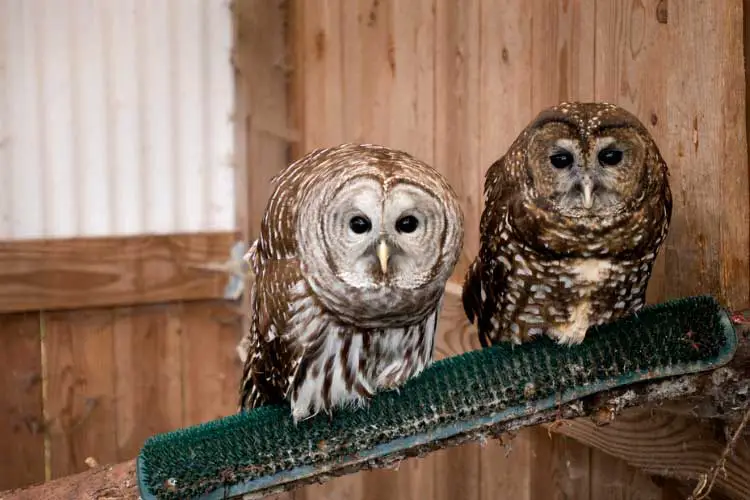
The spotted owl, a creature of twilight whispers and ancient forests, once ruled the canopy with an almost regal indifference to the world below. But today, its kingdom is crumbling—not from the claws of a rival, but from the slow, suffocating grip of habitat fragmentation, the fiery wrath of wildfires, and the relentless encroachment of a cunning usurper: the barred owl. This is not just a tale of ecological decline; it is a saga of survival, where the fate of one owl species hangs in the balance, suspended between the past’s grandeur and an uncertain future.
The Vanishing Canopy: How Habitat Fragmentation Erods the Spotted Owl’s Domain
The spotted owl thrives in the dense, old-growth forests of the Pacific Northwest, where towering Douglas firs and ancient redwoods weave a labyrinth of shadows and secrets. But these forests, once unbroken and endless, now resemble a patchwork quilt stitched together by human hands—each fragment a shrinking island in a sea of development, logging, and agricultural sprawl. Habitat fragmentation is not merely a loss of trees; it is the unraveling of an entire ecosystem’s fabric.
Imagine a symphony orchestra where half the musicians have been silenced. The spotted owl, a creature of precision and patience, depends on vast, uninterrupted territories to hunt, nest, and raise its young. When forests are carved into isolated pockets, the owl’s hunting grounds splinter like cracked glass. Prey becomes scarce. Territories overlap. Competition intensifies. And in this fractured landscape, the owl’s once-reliable rhythms of survival falter. The forest, now a mosaic of fragments, no longer hums with the harmony it once did—it whispers in broken notes, each one a warning.
The Inferno’s Wrath: Wildfires as a Catalyst for Decline
If habitat fragmentation is the slow strangulation of the spotted owl’s world, wildfires are the sudden, searing blow that accelerates its demise. Climate change has turned the Pacific Northwest into a tinderbox, where summers scorch the earth and autumn winds fan the flames into infernos that devour entire ecosystems in hours. For the spotted owl, these fires are not just a threat—they are an existential reckoning.
Consider the ancient forests, where centuries-old trees stand as silent sentinels. These giants, with their thick bark and towering canopies, are not just homes—they are fortresses. But when wildfires rage, even the mightiest of these trees can fall. The understory, once a lush underworld of ferns and fungi, becomes a charnel house of ash and embers. The owl, adapted to the cool, moist embrace of old-growth forests, finds itself adrift in a scorched wasteland. Recovery is slow. Some patches may never return to their former glory. And in the wake of these fires, the barred owl—more adaptable, more aggressive—moves in, claiming the territory the spotted owl can no longer defend.
The irony is bitter: the very forces that once shaped these forests—fire, wind, and time—are now their undoing. The spotted owl, a creature of patience and endurance, is being outpaced by the relentless march of change.
The Barred Owl: A Cunning Rival in an Unfair Contest
Enter the barred owl, a relative newcomer to the Pacific Northwest, its haunting, who-who-who-who call echoing through forests it was never meant to inhabit. Native to the eastern United States, this owl has expanded its range westward with a quiet, almost imperceptible expansion—until it was too late. The barred owl is not just a competitor; it is a disruptor, a silent invader that thrives in the very conditions that spell doom for the spotted owl.
Where the spotted owl is a creature of shadows, the barred owl is a generalist, adaptable to fragmented forests, urban edges, and even agricultural landscapes. It is larger, more aggressive, and more vocal—its calls a taunt in the night. It outcompetes the spotted owl for food, for nesting sites, and for territory. Worse still, it hybridizes with the spotted owl, diluting the genetic purity of a species already on the brink. The barred owl does not need ancient forests to survive; it thrives where the spotted owl falters.
This is not just a battle of species—it is a clash of evolutionary strategies. The spotted owl, honed by millennia of life in the deep woods, is ill-equipped for the chaos of a changing world. The barred owl, meanwhile, is a survivor, a shape-shifter that bends to the will of the modern landscape. The result is a David-and-Goliath story, but one where David is losing—and Goliath is winning by default.
The Domino Effect: Cascading Consequences of Spotted Owl Decline
The decline of the spotted owl is not an isolated tragedy—it is a crack in the foundation of an entire ecosystem. The spotted owl is a keystone species, its presence a barometer of forest health. When it falters, the ripple effects are felt across the web of life. Prey populations surge unchecked. Predators scramble for alternatives. Plant communities shift in response to altered seed dispersal. The forest, once a thriving metropolis of life, begins to resemble a ghost town.
Consider the northern flying squirrel, a primary prey for the spotted owl. Without the owl’s predation, squirrel numbers explode, leading to overgrazing of truffles and fungi—organisms critical to forest regeneration. The forest floor, once a living carpet of mycorrhizal networks, becomes barren. Seedlings struggle to take root. The ancient giants, unable to regenerate, slowly die off. And in their place, invasive species move in, their roots shallow, their canopies weak. The forest is not just fragmented—it is being rewired, its very DNA altered by the absence of its most iconic inhabitant.
This is the tragedy of the spotted owl: its decline is not just a loss for the owl itself, but a signal that the forest is sick—and the prognosis is grim.
Can the Spotted Owl Be Saved? The Fight for a Future in the Shadows
Yet all is not lost. Conservationists, scientists, and policymakers are engaged in a desperate race against time to pull the spotted owl back from the brink. The strategies are as varied as they are controversial: captive breeding programs, habitat restoration, barred owl culls, and strict forest protections. Each carries its own risks and ethical dilemmas, but the goal is the same—to give the spotted owl a fighting chance in a world that seems determined to erase it.
Habitat restoration is the most hopeful avenue. By replanting old-growth species, thinning overly dense forests to mimic natural fire regimes, and creating wildlife corridors to reconnect fragmented patches, conservationists are attempting to stitch the forest back together. But restoration is a slow, painstaking process—one that requires decades, not years, to bear fruit. And in the meantime, the barred owl continues its relentless advance.
Some argue for more drastic measures, including the controversial culling of barred owls to reduce competition. The idea is heartbreaking—how can we, as stewards of the natural world, justify the taking of one life to save another? But the alternative is watching the spotted owl slip into extinction, a fate no less cruel. It is a moral quandary with no easy answers, a reminder that conservation is not just about saving species, but about making impossible choices.
The fate of the spotted owl hangs in the balance, suspended between the past’s grandeur and an uncertain future. Will we act in time? Or will we stand by as the forest’s last great owl fades into memory, a ghost of the ancient woods it once called home?