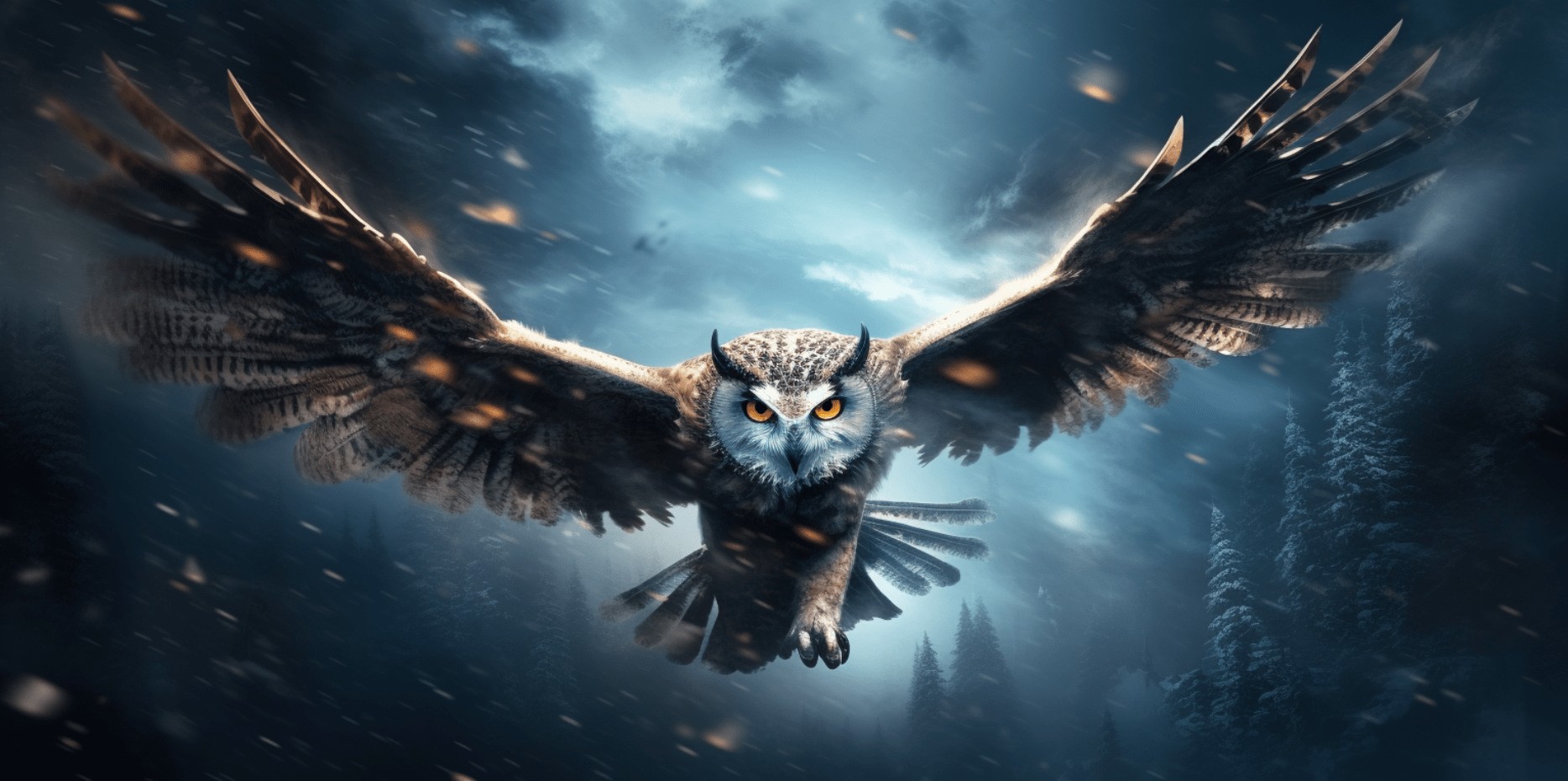
What if I told you that the wise old owl, perched silently on the branches of Yggdrasil, wasn’t just a bird—but a silent guardian of secrets, a whisperer of fate, and a celestial librarian of the gods? In the shadowed tapestry of Norse mythology, where ravens croak prophecies and wolves howl at the moon, the owl emerges not as a mere creature of the night, but as a luminous paradox: both a companion to the Allfather and a symbol of esoteric knowledge. But here lies the riddle: if wisdom is power, why do we so often overlook the owl’s role in shaping the very myths we revere? Let us unfurl this ancient scroll and uncover the untold story of the owl in Norse lore—a tale woven with feathers, fate, and fierce feminine energy.
The Owl as Odin’s Shadow: A Silent Witness to Cosmic Secrets
Picture this: Odin, the one-eyed wanderer with a cloak of raven feathers, gazing into the abyss of Mimir’s well. His gaze is not alone. Perched beside him, unblinking and unshaken by the weight of the cosmos, is the owl. Not as a servant, but as a silent confidant. In the Norse pantheon, where every creature—from the mighty Fenrir to the humble squirrel Ratatoskr—plays a role in the grand drama of existence, the owl occupies a liminal space: neither predator nor prey, neither god nor mortal, but a bridge between worlds.
The owl’s association with Odin isn’t merely decorative. It is symbolic of the god’s own duality—his ability to see in darkness, to hear whispers beyond mortal comprehension, and to navigate the treacherous waters of fate. While the ravens Huginn and Muninn (Thought and Memory) soar across the nine realms, the owl remains grounded, a sentinel of stillness. It is the eye that does not blink, the mind that does not waver. In this capacity, the owl becomes more than a bird; it is the embodiment of Odin’s unyielding pursuit of knowledge, a living metaphor for the scholar’s vigilance.
Wisdom in the Dark: The Owl as Keeper of Forbidden Knowledge
Wisdom, in Norse thought, is not a gentle light—it is a flame that burns in the darkest corners of the mind. The owl, with its nocturnal habits and piercing gaze, personifies this kind of wisdom. Unlike the sunlit sagacity of Apollo or the balanced intellect of Athena, Norse wisdom is raw, unfiltered, and often dangerous. To know too much is to invite chaos, as Odin himself discovered when he sacrificed an eye for a sip from Mimir’s well.
Consider the owl’s role in the myth of the creation of the runes. In the *Hávamál*, Odin recounts how he hung from Yggdrasil for nine nights, pierced by his own spear, to gain mastery over the runic alphabet. But who, one might ask, was there to witness this act of divine masochism? The owl. Its presence is implied in the stillness of the night, in the hush of the world as the Allfather descends into the abyss. The owl does not judge. It does not interfere. It simply *knows*. And in knowing, it becomes a symbol of the wisdom that comes not from books or teachers, but from the crucible of suffering and solitude.
The Feminine and the Feathery: Reclaiming the Owl’s Lost Power
Here is where the story takes a turn—where the owl’s narrative intersects with the forgotten voices of Norse mythology. In a pantheon dominated by thunderous gods and howling beasts, the owl stands out as a creature of quiet intensity. But its significance goes deeper still. In many ancient cultures, the owl is associated with goddesses of wisdom and war—Athena in Greece, Lilith in Mesopotamian lore. Yet in Norse tradition, the owl’s feminine connection is often overlooked, overshadowed by the ravens and wolves that dominate the masculine sphere.
What if the owl was, in fact, a companion to the Vanir goddesses—Freyja, with her cloak of falcon feathers, or the enigmatic Nerthus, goddess of the earth? The owl’s silent flight mirrors the stealth of Freyja’s *fylgja* (fetch spirit), the shadowy double that accompanies warriors and seers. Its ability to navigate the underworld aligns with the Vanir’s dominion over fertility and the unseen. To reclaim the owl’s feminine essence is to acknowledge that wisdom in Norse myth is not solely the domain of Odin’s brooding intellect—it is also the domain of the earth, the moon, and the untamed wilds.
From Myth to Modernity: The Owl’s Enduring Enigma
The owl’s journey doesn’t end with the fall of the Norse gods. It persists in the folklore of Scandinavia, where it is both revered and reviled. In Swedish tradition, the owl is a harbinger of death—a silent omen that glides through the forest before a tragedy. In Norwegian tales, it is a guardian of hidden treasures, its golden eyes reflecting the secrets buried in the earth. But in modern times, the owl has been reduced to a mere mascot, a cartoonish symbol of wisdom in children’s stories. Where did the myth go? Why has the owl’s complexity been flattened into a single, simplistic archetype?
Perhaps the answer lies in our discomfort with ambiguity. The owl does not offer easy answers. It does not chirp in daylight. It does not perform for our applause. It is the creature that thrives in the liminal, the threshold between life and death, knowledge and ignorance. To truly understand the owl in Norse mythology is to embrace the discomfort of not knowing—of sitting in the dark and trusting that the answers will come, not in a blaze of revelation, but in the quiet, insistent whisper of a feathered sage.
The Challenge: Can We Reclaim the Owl’s True Legacy?
So here is the challenge, posed not as a demand, but as an invitation: Can we, in an age of instant knowledge and algorithmic wisdom, reclaim the owl’s role as a symbol of *true* understanding? Can we move beyond the superficial—beyond the owl as a logo for a yoga studio or a sticker on a laptop—and see it for what it truly is: a reminder that wisdom is not a commodity to be consumed, but a journey to be endured?
The owl does not offer comfort. It offers clarity. It does not promise answers. It promises the courage to ask the right questions. And perhaps, in a world drowning in noise, that is the most radical act of all—to sit in silence, to listen to the whispers of the night, and to trust that the owl, perched in the branches of our own minds, is guiding us toward something greater than ourselves.