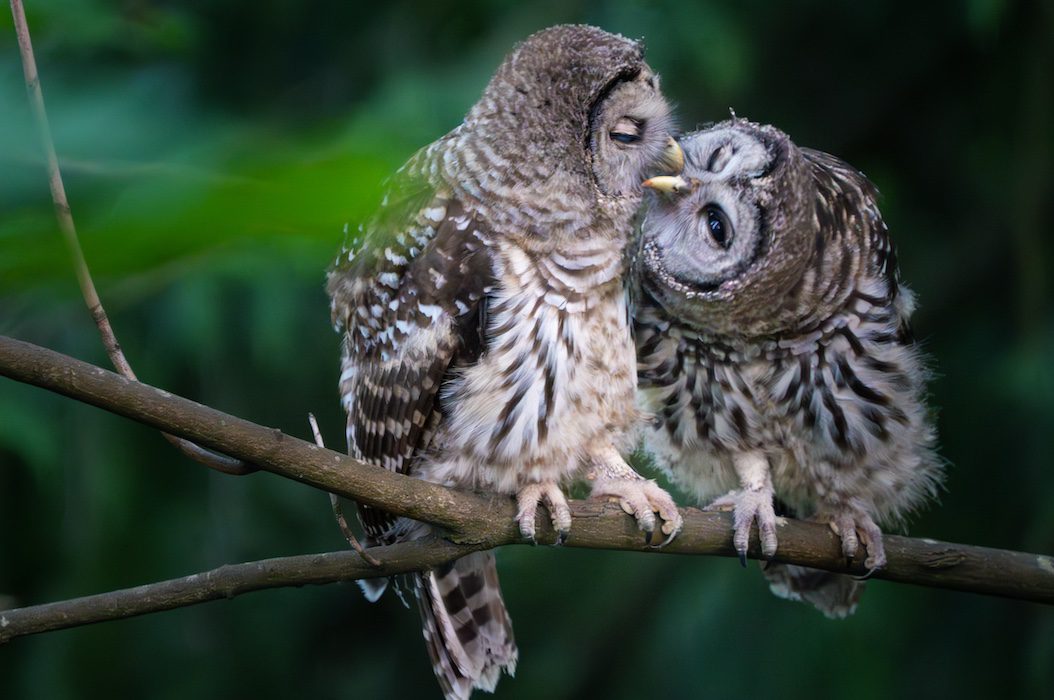
The barred owl, with its haunting, rhythmic call that echoes through the ancient forests like a whispered secret, has become an unlikely protagonist in one of America’s most contentious wildlife sagas. The U.S. Fish and Wildlife Service’s proposed $1.35 billion management plan to cull barred owls in the Pacific Northwest isn’t just about numbers—it’s a collision of ecological necessity, ethical ambiguity, and the tangled legacy of human intervention in nature. This isn’t a simple story of predator and prey; it’s a labyrinthine narrative where every decision casts long shadows, where the past clings to the present like ivy to stone, and where the very definition of conservation is being rewritten in real time.
The Barred Owl as an Unwitting Scapegoat: A Parable of Ecological Displacement
Imagine, for a moment, a quiet forest where the air hums with the soft rustle of ferns and the distant drumming of a pileated woodpecker. This is the domain of the northern spotted owl, a reclusive bird whose existence has been as fragile as a spider’s silk. But the barred owl, a relative newcomer to these ancient woodlands, has arrived with the stealth of an opportunist and the tenacity of a survivor. Originally a denizen of eastern forests, it has expanded westward with a voracious appetite for territory, outcompeting its spotted cousin for food and nesting sites. The barred owl didn’t ask to be the villain in this ecological drama—it simply followed the irresistible pull of unclaimed habitat, a living testament to nature’s relentless adaptability.
Yet, in the eyes of conservationists, the barred owl has become a spectral harbinger of imbalance. Its presence is not just a symptom of change but a catalyst for it, a feathered disruptor that has forced scientists to confront an uncomfortable truth: sometimes, the most effective way to save a species is to remove another. This is not a tale of good versus evil, but of competing imperatives—where the survival of one creature demands the sacrifice of another. The barred owl, in this context, is less a villain and more a mirror, reflecting back the unintended consequences of human actions, from climate change to habitat fragmentation.
The Fiscal and Philosophical Weight of $1.35 Billion: Conservation as a Moral Ledger
A billion dollars is a sum so vast it borders on the abstract, a figure that could fund entire cities or erase entire ecosystems. To spend $1.35 billion on a single species management plan is to make a statement—not just about the value of biodiversity, but about the value we place on the ethical dilemmas inherent in conservation. This is not a budget line item; it’s a moral ledger, where every dollar spent on barred owl removal is a dollar weighed against the survival of the northern spotted owl, against the integrity of old-growth forests, against the very idea of wilderness as a static, untouchable ideal.
The plan’s critics argue that it’s a bandage on a bullet wound, a costly intervention that fails to address the root causes of the barred owl’s expansion. Why, they ask, are we not investing in habitat restoration, in climate adaptation strategies, in the kind of systemic change that could prevent such crises before they arise? The answer lies in the urgency of the moment. The northern spotted owl is teetering on the edge of extinction, and in the calculus of conservation, sometimes triage is the only option. The $1.35 billion is not just a financial commitment; it’s a declaration that some battles are worth fighting, even if the cost is high and the victory uncertain.
The Barred Owl’s Silent Rebellion: Nature’s Unruly Protagonist
There is a rebellious streak in the barred owl’s story, a defiance that makes it more than just a passive participant in this ecological drama. Unlike the northern spotted owl, which clings to its dwindling territory with the desperation of a creature fighting for its last breath, the barred owl thrives. It adapts. It colonizes. It refuses to be confined by the boundaries humans have drawn on maps or in policy documents. In this sense, the barred owl is nature’s anarchist, a creature that refuses to play by the rules of a world that is rapidly unraveling.
This rebellion is not without its charm. The barred owl’s eerie, eight-note call—often described as “Who cooks for you? Who cooks for you-all?”—is a haunting melody that has echoed through forests for centuries. But in the Pacific Northwest, it has become a siren song of disruption, a reminder that nature is not a static tableau but a dynamic, ever-shifting tapestry. The barred owl’s success is a challenge to the notion of balance, a rebuke to the idea that ecosystems are delicate, fragile things that must be preserved in amber. Instead, it forces us to ask: what does balance even mean in a world where the rules are constantly being rewritten?
The Ghosts of Conservation Past: Lessons from the Wolf Wars
To understand the barred owl management plan, we must look to the past—not just to the forests of the Pacific Northwest, but to the wolves of Yellowstone. In the 1990s, the reintroduction of gray wolves to the park sparked a fierce debate about the role of predators in ecosystems. Some saw the wolves as saviors, restoring balance to a landscape that had been artificially sterilized by their absence. Others viewed them as interlopers, a threat to the status quo. The parallels to the barred owl debate are striking: a species arrives, disrupts the existing order, and forces humans to confront their own complicity in the disruption.
The wolf wars taught us that conservation is never just about science—it’s about values, about identity, about the stories we tell ourselves about what nature should be. The barred owl, like the wolf, is a creature that defies easy categorization. It is neither purely villain nor hero, but a living, breathing reminder that nature is not a museum piece to be preserved under glass. It is a wild, untamed force that refuses to be tamed, and in its refusal, it forces us to ask uncomfortable questions about our own place in the world.
The Future of Wildlife Policy: A Crossroads of Ethics and Ecology
The barred owl management plan is more than a policy document—it is a Rorschach test for the future of wildlife conservation. Will we cling to the idea of nature as a pristine, unchanging ideal, or will we embrace a more fluid, adaptive approach to conservation? Will we see the barred owl as a symptom of our own failures, or as a catalyst for a new way of thinking about coexistence?
The answers to these questions will shape the next century of wildlife policy. If we choose to see the barred owl as an enemy to be eradicated, we risk repeating the mistakes of the past, where short-term fixes led to long-term consequences. But if we choose to see it as a teacher, a creature that forces us to confront the complexities of a changing world, then perhaps we can begin to build a conservation ethos that is as dynamic and resilient as the ecosystems it seeks to protect.
The barred owl’s call will continue to echo through the forests, a haunting reminder that nature is not a static painting but a living, breathing entity. And in that echo, we may yet find the wisdom to navigate the uncertain future that lies ahead.