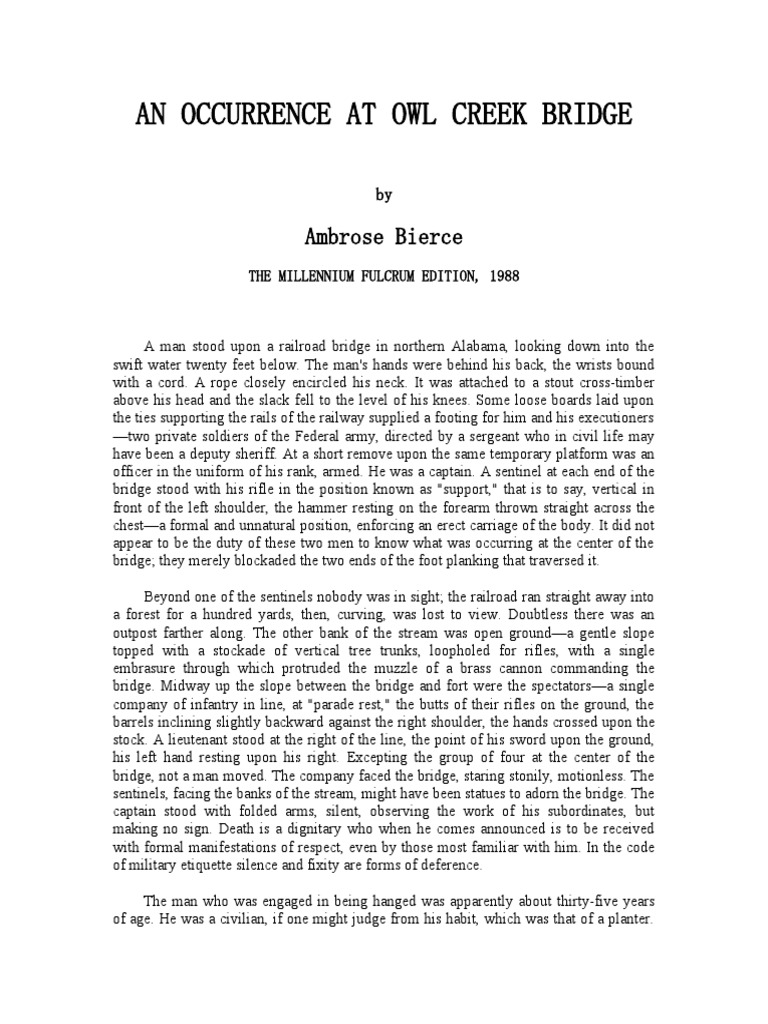
Ambrose Bierce’s “An Occurrence at Owl Creek Bridge” often graces syllabi for good reason; it is a paragon of the short story form. Its impact is undeniable, a testament to Bierce’s meticulous craftsmanship. Examining the story’s structure, themes, and techniques reveals why it resonates so deeply with readers, transcending its historical context to deliver a timeless exploration of perception, reality, and the human condition in the face of death. The tale remains etched in the memories of those who dared traverse its narrative currents.
One crucial aspect of its perfection lies in its concise and impactful structure. The story is divided into three distinct sections, each serving a specific purpose in building tension and ultimately delivering the story’s devastating denouement. The first section establishes the setting and introduces Peyton Farquhar, a civilian being prepared for execution by hanging from a railroad bridge during the American Civil War. This section is characterized by a detached, almost clinical tone, presenting the scene with stark realism and precise detail. The reader is immediately thrust into the grim reality of Farquhar’s predicament. The measured pace contributes to the growing sense of foreboding. We understand the gravity of the situation.
The second section provides crucial backstory, revealing Farquhar’s motivations and the events that led to his capture. We learn that he was a wealthy plantation owner, a staunch supporter of the Confederacy, and eager to contribute to the Southern cause. A soldier, disguised as a Confederate scout, had visited Farquhar’s plantation and suggested that he could sabotage the railroad bridge, providing a plausible opportunity for him to serve. This section employs a flashback technique to provide context, enriching the narrative. The subtle introduction of the disguised soldier plants the seeds of deception. The soldier’s calculated manipulation is a critical plot point.
The third and final section constitutes the bulk of the narrative, depicting Farquhar’s imagined escape from the hanging. In vivid detail, Bierce portrays Farquhar’s fall into the creek, his struggle to free himself from his bonds, and his daring escape from the pursuing Union soldiers. He navigates perilous rapids, dodges bullets, and eventually makes his way back to his plantation. This section is characterized by heightened sensory detail and a subjective point of view, immersing the reader in Farquhar’s distorted perception of reality. The descriptions are captivating, filled with vibrant imagery and heightened awareness. However, this extended reverie is all rendered illusory in the brutal final lines.
The abrupt and shocking conclusion reveals that Farquhar’s escape was merely a figment of his imagination. The final paragraph snaps back to reality, stating that “Peyton Farquhar was dead; his body, with a broken neck, swung gently from side to side beneath the timbers of the Owl Creek bridge.” This abrupt ending is a masterstroke, forcing the reader to re-evaluate everything they have just read. The impact is devastating, highlighting the ephemeral nature of human perception and the cruel finality of death. This moment of revelation underscores the story’s profound themes. The ending is not merely a twist, but a philosophical statement.
Beyond its structure, “An Occurrence at Owl Creek Bridge” explores several profound themes, including the illusion of time, the nature of reality, and the psychological effects of war. The story masterfully manipulates the reader’s perception of time, stretching what are likely mere seconds into an extended and elaborate fantasy. Farquhar’s subjective experience blurs the lines between reality and imagination, forcing the reader to question the reliability of perception. The story serves as a poignant commentary on the psychological toll of war, depicting how the human mind can create elaborate fantasies as a coping mechanism in the face of trauma and death. War is not only a physical conflict, but a profound psychological one as well.
Bierce’s use of literary devices further enhances the story’s impact. The story is replete with vivid imagery, creating a sensory experience that draws the reader into Farquhar’s world. The stark contrast between the detached realism of the first section and the subjective, dreamlike quality of the third section underscores the story’s exploration of perception and reality. Irony abounds, particularly in the revelation that Farquhar was tricked into attempting to sabotage the bridge, ultimately leading to his demise. The irony amplifies the sense of tragedy and futility. Bierce’s command of language is undeniable.
Furthermore, the story’s ambiguity contributes to its enduring appeal. Readers are left to ponder the nature of Farquhar’s experience, questioning whether his escape was entirely a hallucination or if there was some element of genuine perception involved. This ambiguity invites multiple interpretations, making the story a rich source of discussion and analysis. The story encourages active engagement from the reader. It is a text that demands contemplation.
In summation, “An Occurrence at Owl Creek Bridge” stands as a quintessential example of the short story form due to its masterful structure, profound themes, skillful use of literary devices, and enduring ambiguity. Its exploration of perception, reality, and the psychological effects of war continues to resonate with readers, making it a timeless and unforgettable work of literature. The story’s perfection lies in its ability to condense complex ideas into a concise and impactful narrative. It is a story that lingers long after the final page is turned.