Ever wondered if a single moment could stretch into an eternity, warped by the desperate machinations of a dying mind? Ambrose Bierce’s “An Occurrence at Owl Creek Bridge” masterfully explores this unsettling concept. The narrative hinges on its meticulously crafted setting, a landscape both physically tangible and psychologically fraught. But how effectively does Bierce weave place into the very fabric of Farquhar’s doomed existence, and how does this intricate tapestry contribute to the story’s enduring power?
The story’s setting isn’t merely a backdrop; it’s an active participant, shaping Farquhar’s perceptions and ultimately dictating his fate. Let’s dissect the key locales, examining how Bierce imbues them with symbolic weight and atmospheric tension.
The Bridge: A Stage for Execution and Illusion
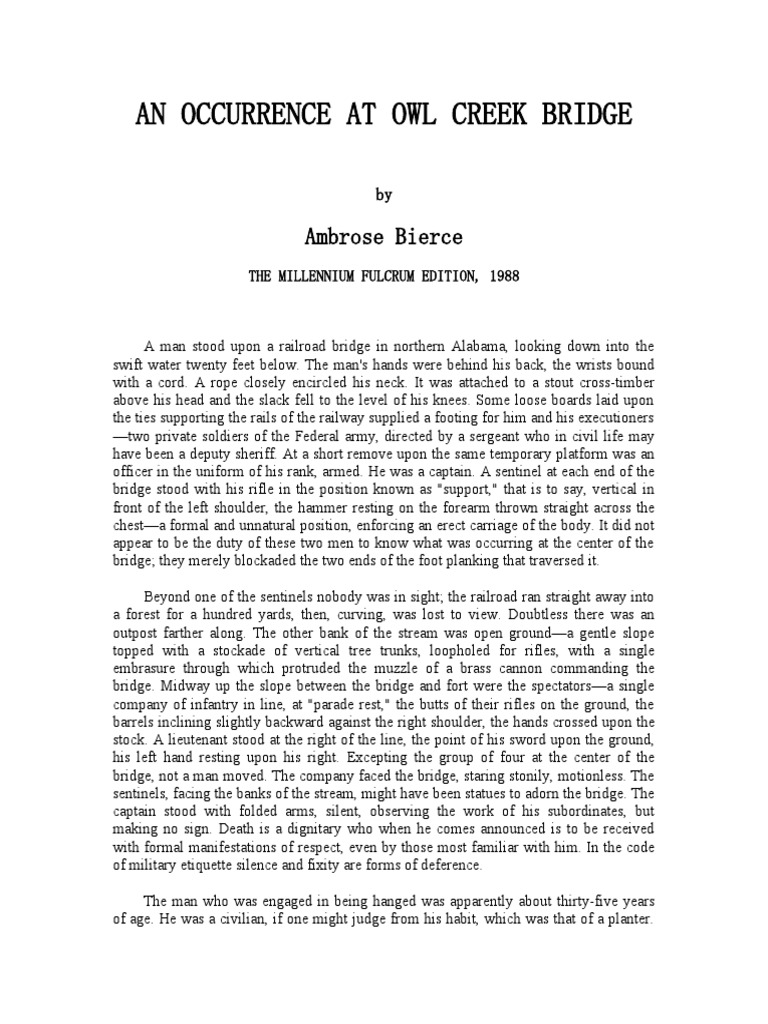
Owl Creek Bridge itself stands as the story’s pivotal point, both literally and figuratively. Initially, it is a stark and grim stage for Farquhar’s impending execution. The Union soldiers, described with an almost mechanical detachment, further accentuate the cold precision of the scene. The bridge’s physical structure, spanning the seemingly impassable creek, becomes a symbol of the chasm between life and death, a gulf Farquhar desperately tries to traverse, first in reality, then in his mind.
Consider the precise details Bierce provides: the unwavering gaze of the sentinels, the rhythmic ticking of Farquhar’s watch amplified to an unbearable degree. These sensory amplifications foreshadow the altered perception of time that will characterize Farquhar’s escape fantasy. The bridge, therefore, represents not just a place of death but also the threshold to a distorted reality, a final, desperate attempt to cling to life.
The Creek: A Siren Song of Hope and Deception
Owl Creek, the waterway flowing beneath the bridge, initially appears as a potential avenue of escape. Farquhar, in his fantastical flight, plunges into its depths, finding himself miraculously unbound and propelled forward. The creek, therefore, embodies a fleeting sense of hope, a tantalizing promise of salvation. However, this hope is ultimately revealed as illusory. The creek, initially a source of liberation, leads Farquhar deeper into his hallucinatory journey, further distancing him from the cold, hard truth of his situation.
The water itself is described with evocative language, reflecting Farquhar’s shifting emotional state. At first, it is a cool, refreshing balm. Later, it becomes a turbulent, relentless force, mirroring the mounting desperation and frantic energy that fuels his imagined flight. The creek is a dynamic element, its character shifting in tandem with Farquhar’s psychological unraveling.
The Forest: A Labyrinth of Memory and Delusion
Once Farquhar purportedly escapes the immediate clutches of the Union army, he finds himself immersed in the seemingly boundless wilderness of the forest. This forest is not a sanctuary, but rather a labyrinth of distorted memory and burgeoning delusion. The journey through the woods is fraught with increasingly surreal and improbable occurrences, reflecting the fraying edges of Farquhar’s sanity.
The descriptions of the forest become increasingly subjective and unreliable. The sounds and sights are amplified and distorted. Familiar landmarks take on grotesque and menacing forms. The forest, therefore, becomes a physical manifestation of Farquhar’s internal turmoil, a space where the boundaries between reality and imagination completely dissolve.
The Home: A Beacon of Nostalgia and Futile Longing
Farquhar’s ultimate destination, his home, represents the idealized past, a refuge of domestic tranquility and familial love. The vivid imagery used to depict his wife and children underscores the poignant nature of his loss and the profound desire that fuels his desperate flight. This idealized home serves as a powerful symbol of what Farquhar is fighting to preserve, even as his grasp on reality slips away.
However, the homecoming is tragically brief and brutally abrupt. The final, jarring image of Farquhar embracing his wife before feeling the unbearable pain in his neck shatters the illusion, revealing the devastating truth of his demise. The idyllic home becomes a cruel mirage, a stark reminder of the life he has forfeited. The setting therefore culminates in a profound sense of disillusionment, highlighting the futility of Farquhar’s struggle and the crushing weight of his fate.
In conclusion, the setting of “An Occurrence at Owl Creek Bridge” is far more than just window dressing. Bierce masterfully crafts each location, imbuing it with symbolic weight and atmospheric resonance. The bridge, the creek, the forest, and the home all contribute to the story’s haunting and unforgettable impact. By meticulously detailing the physical environment and intertwining it with Farquhar’s psychological state, Bierce creates a powerful and enduring exploration of the blurred lines between reality and perception, life and death.