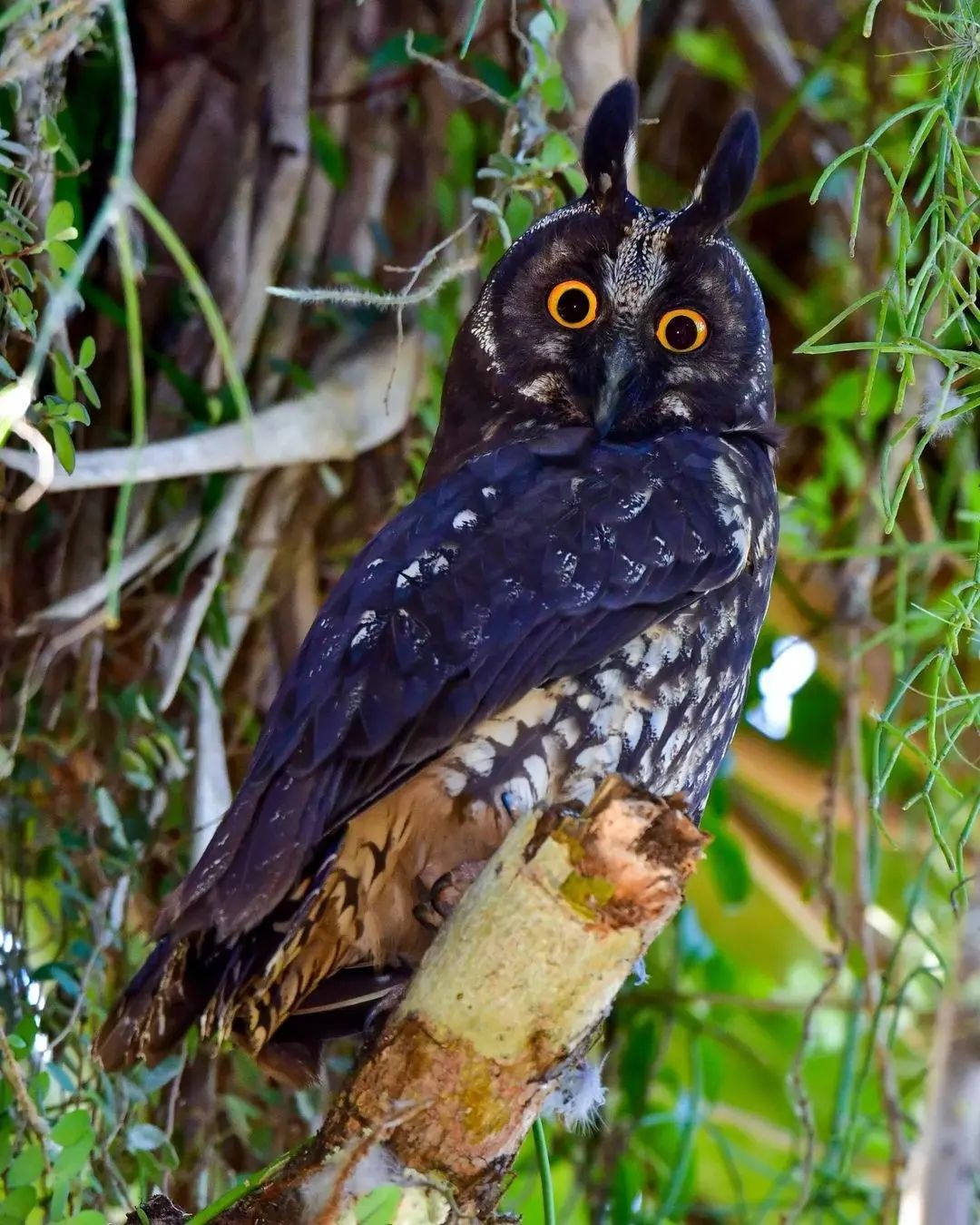
The Stygian Owl, a creature of twilight whispers and shadowed forests, is one of the most enigmatic and visually arresting raptors of the Americas. Cloaked in a plumage that seems to absorb the fading light of dusk, this nocturnal sentinel embodies the mystique of the wild places it inhabits. With eyes like molten gold and a silhouette that evokes both elegance and primal ferocity, the Stygian Owl is not merely a bird—it is a living emblem of the untamed wilderness. Its presence, often felt more than seen, invites us into a world where silence speaks louder than sound and where every rustle in the undergrowth could be the prelude to a fleeting encounter with one of nature’s most elusive predators.
The Enigmatic Allure of the Stygian Owl’s Appearance
The Stygian Owl, scientifically known as *Asio stygius*, is a masterpiece of evolutionary artistry, its physical traits a testament to its adaptation to the crepuscular realm. Standing at a modest 38 to 46 centimeters in height, its compact yet robust frame belies its formidable presence. The owl’s plumage is a symphony of dark hues—deep browns, sooty blacks, and earthy tans—mottled in a pattern that renders it nearly invisible against the bark of ancient trees or the dense foliage of its forest abode. Its facial disc, a striking feature shared by many owls, is a radiant halo of white and buff feathers, framing eyes that burn with an almost supernatural intensity. These eyes, large and round, are a marvel of avian biology, capable of detecting the faintest glimmer of movement in the inky blackness of night. The Stygian Owl’s ear tufts, though not true ears, add to its mystique, lending it an air of perpetual vigilance. Even its talons, curved and razor-sharp, speak of a predator finely tuned to the art of the hunt.
Habitat and Range: A Wanderer of the Americas’ Hidden Corners
The Stygian Owl’s domain stretches across a vast and varied tapestry of landscapes, from the mist-shrouded cloud forests of Central America to the temperate woodlands of South America’s southern cone. It thrives in regions where the canopy is dense enough to provide cover yet open enough to allow for silent, swift flight. In Mexico and Guatemala, it haunts the highland pine-oak forests, while in Argentina and Chile, it ventures into the temperate rainforests and shrublands. This owl is a creature of elevation, often found at heights between 1,000 and 3,000 meters, where the air is crisp and the nights are long. Its range, though not as expansive as some of its more adaptable cousins, is a testament to its resilience in the face of habitat fragmentation. Yet, the Stygian Owl remains a rare sight, its presence often inferred from the eerie calls that echo through the night or the telltale signs of its predation—feathers and bones scattered beneath its favored perches.
Diet and Hunting: The Silent Symphony of the Night
To witness the Stygian Owl in its element is to observe a predator operating at the peak of its craft. Its diet is a reflection of its opportunistic nature, though it shows a particular affinity for small mammals such as rodents, shrews, and even bats. Insects, too, feature prominently in its menu, particularly during the warmer months when the night air hums with the activity of crickets, moths, and beetles. The owl’s hunting technique is a blend of patience and precision. It perches motionless for hours, its keen senses attuned to the slightest disturbance in the undergrowth. When prey is detected, it launches into a silent descent, its wings slicing through the air with barely a whisper. The strike is swift and lethal, a testament to the owl’s evolutionary prowess. Unlike its more gregarious relatives, the Stygian Owl is a solitary hunter, its hunts a solitary dance between predator and prey, played out under the watchful gaze of the moon.
Behavior and Social Dynamics: The Solitary Sovereign of the Shadows
The Stygian Owl is a creature of solitude, its social interactions limited to the breeding season and the occasional territorial disputes with rivals. Unlike the communal roosts of some owl species, this bird prefers the company of its own thoughts—or lack thereof—spending its days hidden among the dense foliage or within the hollows of ancient trees. Its call, a haunting series of low, resonant hoots that rise and fall like the tide, is a sound that sends shivers down the spines of those who hear it. This vocalization serves multiple purposes: it marks territory, attracts mates, and perhaps even serves as a form of communication between individuals in the vast, silent expanse of the night. The owl’s behavior is a study in contrasts—while it may appear lethargic during daylight hours, it transforms into a whirlwind of activity once the sun dips below the horizon, its world coming alive in a flurry of nocturnal pursuits.
Reproduction and Lifecycle: The Cycle of Life in the Dark
The breeding season of the Stygian Owl is a fleeting yet intense period, marked by elaborate courtship displays and a fierce dedication to the perpetuation of its lineage. Mating pairs form in the late winter or early spring, their bond cemented through a series of aerial acrobatics and vocal duets that echo through the forest. The female, typically the more selective of the two, lays a clutch of two to four eggs in a nest constructed within the confines of a tree cavity or, on rare occasions, an abandoned nest of another bird. Incubation lasts approximately 28 days, during which the male diligently provisions his mate with food. Once hatched, the chicks are fed a diet of regurgitated prey, their growth a testament to the relentless dedication of their parents. The fledglings, though fully feathered by around six weeks of age, remain dependent on their parents for several months, learning the intricacies of survival in the shadowed world they inhabit. The lifecycle of the Stygian Owl is a delicate balance, a dance between life and death played out in the quiet corners of the natural world.
Conservation Status and Threats: The Fragile Balance of a Shadowy Existence
Despite its elusive nature, the Stygian Owl faces a myriad of threats that imperil its continued existence. Habitat loss, driven by deforestation and agricultural expansion, is perhaps the most pressing concern, fragmenting the owl’s range and isolating populations. Climate change, too, looms as a silent specter, altering the delicate ecosystems upon which the owl depends. Pesticide use, while less directly harmful than habitat destruction, poses a subtler threat by contaminating the owl’s prey and accumulating in its tissues over time. Conservation efforts for the Stygian Owl are still in their infancy, but they offer a glimmer of hope. Protected areas, reforestation initiatives, and community-based conservation programs are slowly gaining traction, aiming to safeguard the owl’s habitat and ensure its survival for generations to come. Yet, the road ahead is fraught with challenges, and the Stygian Owl remains a species that teeters on the edge of obscurity.
Cultural Significance and Folklore: The Owl in the Human Imagination
Throughout history, owls have occupied a unique space in the human psyche, simultaneously revered and feared as omens of wisdom, mystery, and foreboding. The Stygian Owl, with its dark plumage and nocturnal habits, is no exception. In the folklore of indigenous cultures across the Americas, the owl is often depicted as a messenger between the living and the spirit world, a guardian of secrets best left unspoken. In some traditions, its call is seen as a harbinger of death, while in others, it is a symbol of protection and guidance. The Stygian Owl’s presence in these narratives speaks to its role as a bridge between the tangible and the intangible, a creature that embodies the unknown and the unknowable. Even in modern times, the owl continues to captivate the human imagination, its image adorning everything from art to literature, a testament to its enduring allure.
How to Observe the Stygian Owl: A Guide for the Patient and Persistent
For those fortunate enough to venture into the owl’s domain, observing the Stygian Owl is a pursuit that demands patience, perseverance, and a deep respect for the natural world. The best time to search for this elusive creature is during the twilight hours, when the forest is bathed in the soft glow of dusk and the owl begins to stir from its daytime slumber. Listen for its distinctive call—a series of low, rhythmic hoots that rise and fall like a distant wave—and follow the sound with quiet footsteps. Dawn and dusk are also opportune times to spot the owl as it returns to its roost or sets out on its nocturnal hunts. Binoculars and a keen eye are essential, as the owl’s mottled plumage blends seamlessly into the shadows. Remember, the goal is not to disturb but to witness, to connect with a creature that exists on the fringes of our perception, a silent sovereign of the night.