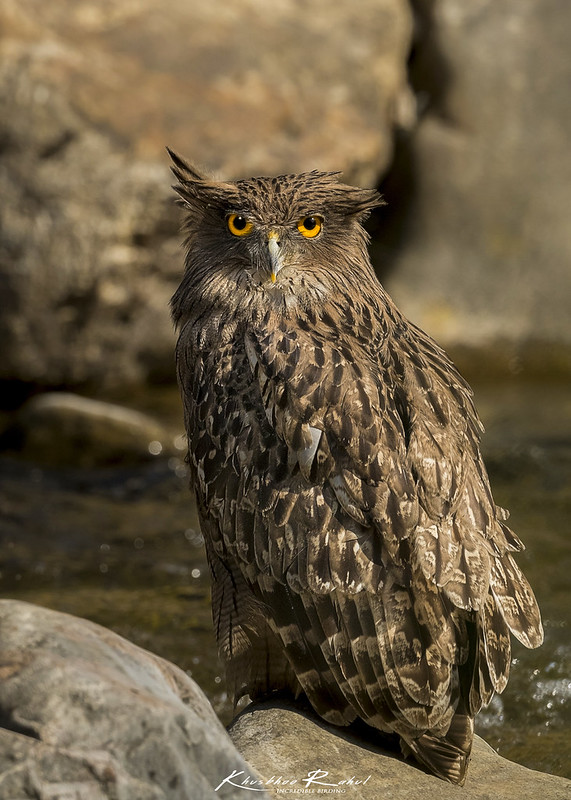
The Blakiston’s Fish Owl, Ketupa blakistoni, is a creature of whispered forests and moonlit rivers, a spectral giant draped in the hush of twilight. Imagine a bird so rare that its very presence feels like a secret shared between the wilderness and the patient observer. This is no ordinary owl—it is a relic of ancient woodlands, a living paradox of power and fragility, a shadow that moves with the quiet authority of a sovereign. To encounter one is to witness a fleeting masterpiece of evolution, a bird whose existence whispers of untold stories buried in the moss-covered banks of remote rivers.
The Phantom of the Taiga: A Bird Wrapped in Mystery
In the dense, mist-laden forests of northeastern Asia, where the air hums with the damp breath of ancient conifers, the Blakiston’s Fish Owl glides like a specter. It is not the kind of bird that announces itself with raucous calls or bold displays. Instead, it moves with the stealth of a thief in the night, its presence known only by the sudden hush of a river’s edge or the faintest ripple of water betraying its nocturnal hunt. This owl is the taiga’s best-kept secret, a creature so elusive that even seasoned ornithologists speak of it in hushed tones, as if the mere mention of its name might shatter the fragile veil of its existence.
Its plumage, a tapestry of earthy browns and smoky grays, is not designed for camouflage in the traditional sense. Rather, it is a masterclass in ambient assimilation—a bird that becomes one with the dappled light and the tangled undergrowth, a living chiaroscuro that defies the eye to pin it down. To find one is to be granted a glimpse into a world where time moves differently, where the boundaries between myth and reality blur like the edges of a watercolor painting left too long in the rain.
The Titan of the Night: Size and Stature in a Feathered World
Standing at nearly two feet tall, with a wingspan that stretches wider than a child’s outstretched arms, the Blakiston’s Fish Owl is a titan among owls. It is not merely large—it is monumental, a bird that commands respect not through aggression, but through an almost regal bearing. Its talons, curved like scythes, are built for the brutal work of subduing prey twice its size, while its eyes, golden and unblinking, burn with the intensity of a furnace in the dark. This is a bird that does not cower; it observes, and in its gaze, one can almost feel the weight of millennia of unspoken wisdom.
Yet, for all its physical grandeur, there is a paradox to its existence. In a world where survival often favors the swift and the cunning, the Blakiston’s Fish Owl is a slow, deliberate hunter. It does not chase. It does not scurry. It waits. Perched on a gnarled branch overhanging a river, it becomes a part of the landscape itself, a silent sentinel watching the water for the telltale flicker of a fish’s tail. This is not the behavior of a predator in a hurry. It is the strategy of a creature that understands the value of patience, of timing, of the perfect moment when the river’s current will deliver its dinner directly into its grasp.
The River’s Whisperer: A Diet of Aquatic Bounty
Unlike its terrestrial cousins, the Blakiston’s Fish Owl is a connoisseur of the aquatic. Its diet is a gourmet affair, a smorgasbord of salmon, trout, and other river-dwelling delicacies that it snatches from the water with a precision that borders on the supernatural. To watch it hunt is to witness a ballet of death and grace. The owl’s wings, broad and silent as a falling leaf, carry it low over the water’s surface. Then—suddenly—it plunges, talons outstretched, vanishing beneath the surface for a heartbeat before erupting with a fish writhing in its grip. The entire act is over in the span of a single breath, a testament to the owl’s mastery of its domain.
This dependence on fish is not merely a dietary preference; it is a covenant with the river. The owl’s survival is inextricably linked to the health of its aquatic home. When rivers run clear and teeming with life, the owl thrives. When pollution chokes the waters or dams disrupt the natural flow, the owl falters. It is a living barometer of ecological balance, a creature whose fate is entwined with the very pulse of the wilderness. To protect the Blakiston’s Fish Owl is to safeguard the rivers themselves—a reminder that in nature, every creature, no matter how grand or how humble, plays a role in the grand symphony of life.
The Lone Sovereign: Social Structure and Solitude
The Blakiston’s Fish Owl is not a social butterfly. It is a loner, a sovereign of its own quiet kingdom, ruling over a territory that can span miles of untouched forest. Mated pairs are a rare sight, their bond forged in the silence of the taiga, their communication reduced to low, guttural hoots that carry through the trees like the echoes of a forgotten language. To witness a pair is to glimpse a relationship built on mutual respect rather than frivolous displays—a partnership where each bird knows its role, where the male’s duty is to hunt and the female’s is to nurture, all beneath the watchful gaze of the ancient forest.
This solitude is not born of indifference, but of necessity. In a world where resources are scarce and competition is fierce, the Blakiston’s Fish Owl has learned the art of self-reliance. It does not squawk for attention. It does not gather in noisy flocks. It exists, a solitary figure in a landscape that is as vast as it is unforgiving. And yet, in its silence, there is a kind of poetry—a reminder that some of the most extraordinary creatures on Earth are those that choose to stand apart, not out of arrogance, but out of an innate understanding of their place in the world.
The Vanishing Act: Conservation and the Fragility of Existence
To speak of the Blakiston’s Fish Owl is to speak of a creature on the brink. Its population is a shadow of what it once was, a ghost of its former glory, hunted by poachers, displaced by deforestation, and starved by the degradation of its riverine habitats. It is a species that does not scream for help. It simply fades, its numbers dwindling like embers in a dying fire. Conservation efforts are underway, but they are a race against time—a battle to preserve the last remnants of the wilderness that this owl calls home.
The irony is cruel. The Blakiston’s Fish Owl, a bird that has survived for millennia, now faces extinction not because of its own failings, but because of the relentless march of human progress. It is a creature that asks for nothing but space, for rivers that run free, for forests that whisper instead of roar. And yet, its survival depends on our willingness to listen, to act, to recognize that some treasures are not meant to be exploited, but cherished.
To lose the Blakiston’s Fish Owl would be to lose a piece of the world’s soul—a bird that embodies the mystery of the wild, the quiet power of patience, the delicate balance of nature. It is a loss that would echo through the ages, a silence that would haunt the forests forever.
The Owl’s Legacy: Why This Bird Matters
The Blakiston’s Fish Owl is more than a bird. It is a symbol. A living metaphor for the wild places that still exist, for the creatures that thrive in the shadows, for the beauty that can be found in stillness. It is a reminder that the world is not just a place of noise and hurry, but of whispers and secrets, of moments suspended in time. To know this owl is to understand that true majesty does not always announce itself with fanfare. Sometimes, it moves silently through the underbrush, leaving behind only the faintest trace—a ripple in the water, a hush in the trees, the flicker of golden eyes in the dark.
And perhaps that is its greatest gift. In a world that often feels too loud, too fast, too crowded, the Blakiston’s Fish Owl offers a different kind of experience—a chance to slow down, to listen, to marvel at the extraordinary hidden in the ordinary. It is a bird that teaches us to see the magic in the mundane, to find wonder in the quiet corners of the world. To lose it would be to lose a part of ourselves—a part that remembers how to be still, how to listen, how to marvel.
So let us not forget. Let us not turn away. The Blakiston’s Fish Owl is waiting, a silent guardian of the last wild places. And it is up to us to ensure that its song is not the last.