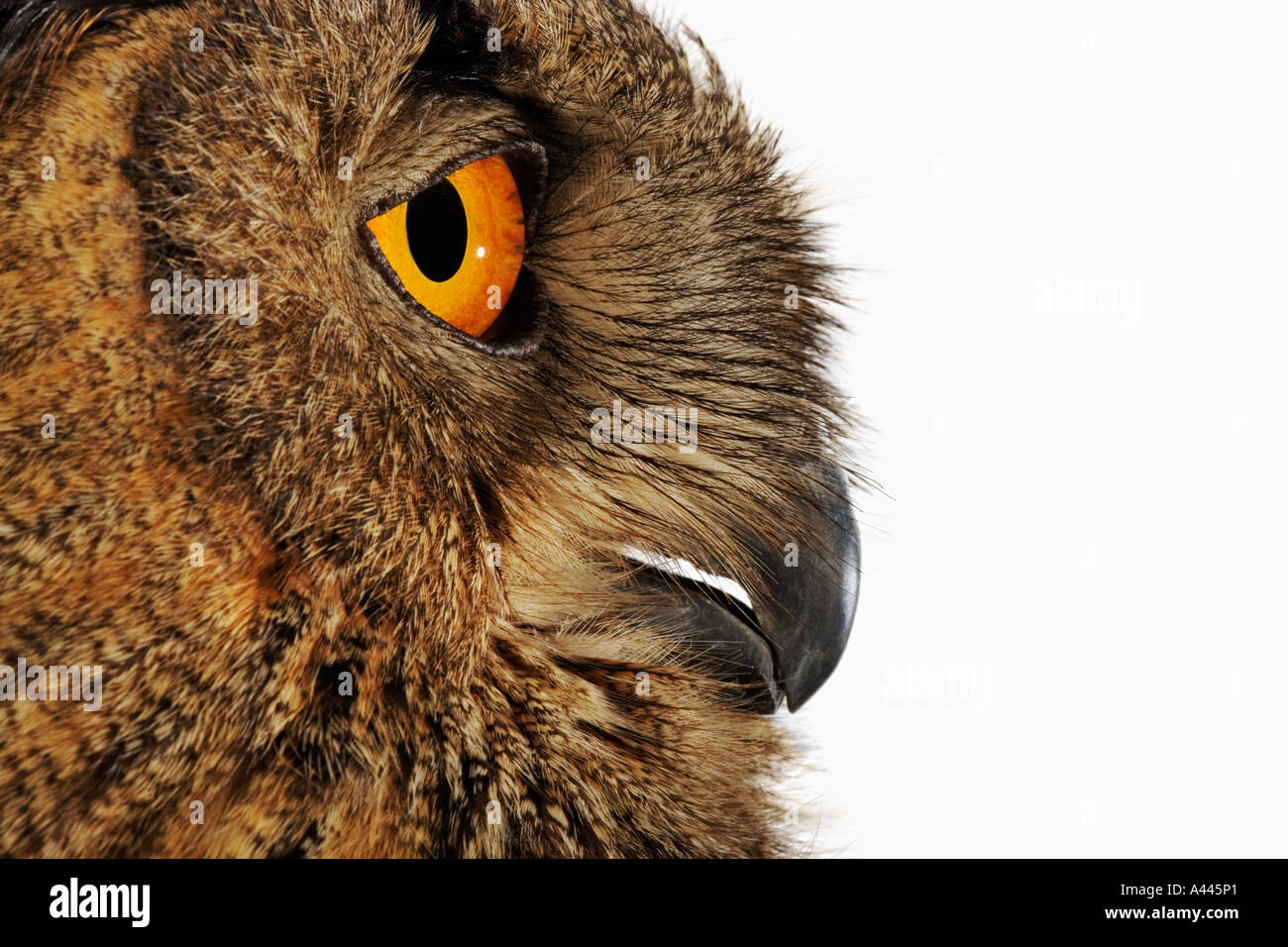
The Eurasian eagle-owl (Bubo bubo) is not merely a bird of the night—it is a living embodiment of primal power, a feathered titan that commands the twilight realms with silent authority. Perched motionless on a cliff’s edge or surveying its domain from the gnarled branches of an ancient oak, this owl exudes an aura of untamed majesty. Its piercing orange eyes, framed by a crown of rust-colored feathers, seem to hold the secrets of forgotten forests and moonlit hunts. To witness an eagle-owl in the wild is to glimpse a creature that has thrived for millennia, unshaken by the march of time. Yet, what is it about this nocturnal sovereign that captivates us so deeply? Is it the sheer size of its wingspan, stretching wider than a child’s outstretched arms? Or perhaps the haunting resonance of its call, a deep, resonant *hoo-hoo* that echoes through the valleys like a ghostly proclamation? The fascination with the eagle-owl runs deeper than mere admiration—it is a testament to humanity’s enduring awe of the wild and the unknown.
The Titan of the Twilight: Size and Strength in the Avian World
The Eurasian eagle-owl is not just large—it is a colossus among birds. With a wingspan that can exceed 180 centimeters (nearly six feet) and a body length nearing 75 centimeters, it stands as Europe’s largest owl, a silent sentinel that casts a shadow over the landscape. Its talons, thick as a human wrist and tipped with obsidian claws, are weapons of precision, capable of crushing the skull of prey with terrifying efficiency. Unlike its smaller cousins, which may dine on insects or rodents, the eagle-owl preys upon creatures as formidable as foxes, young deer, and even other birds of prey. This is no mere hunter—it is a hypercarnivore, a predator at the apex of its food chain.
What truly sets the eagle-owl apart, however, is not just its size but its sheer physicality. Its plumage, a tapestry of earthy browns and mottled grays, provides camouflage against the bark of trees and the rocky outcrops it favors. Yet, when the light catches its feathers just right, they shimmer with an almost metallic sheen, as if woven from the very essence of the wilderness. The owl’s facial disc, a radiant halo of feathers surrounding its eyes, acts as a parabolic dish, funneling sound toward its ears with unparalleled acuity. In the dead of night, it can pinpoint the rustle of a vole beneath a meter of snow—a feat that borders on the supernatural.
The Silent Predator: Mastery of Stealth and Strategy
To observe an eagle-owl in flight is to witness the art of predation distilled into pure motion. Unlike the flapping urgency of smaller birds, the eagle-owl glides on thermals with the effortless grace of a shadow. Its wings, broad and rounded, slice through the air with minimal disturbance, allowing it to approach prey undetected. This stealth is no accident—it is the result of evolutionary refinement. The owl’s primary feathers are serrated along the edges, a feature known as the *fimbriae*, which breaks up airflow and muffles the sound of its passage. In the world of the eagle-owl, silence is not just a virtue; it is a necessity.
Yet, stealth alone does not make a hunter. The eagle-owl’s hunting strategy is a blend of patience and opportunism. It may perch for hours, its gaze fixed on a single patch of ground, waiting for the telltale twitch of a mouse’s tail. When the moment arrives, it strikes with a suddenness that belies its bulk, its talons piercing flesh before the prey can react. But the owl is no mindless killer. It exhibits a discerning palate, often discarding the fur and bones of its meals in neat piles beneath its roost—a behavior that has earned these accumulations the eerie moniker of “owl pellets.” These regurgitated bundles of indigestible remains offer scientists a window into the owl’s diet, revealing a menu that ranges from hedgehogs to bats, and even the occasional snake.
The Haunting Symphony: Vocalizations and Communication
Few sounds in nature are as evocative as the call of the Eurasian eagle-owl. A deep, resonant *hoo-hoo*, delivered in a series of booming notes, it is a vocalization that carries across vast distances, a primal anthem that seems to resonate with something deep within the human psyche. Unlike the high-pitched screeches of smaller owls, the eagle-owl’s voice is a basso profundo, a sound that vibrates through the chest as much as it does through the air. Mated pairs often duet, their calls intertwining in a haunting harmony that echoes through the night.
But the eagle-owl’s vocal repertoire extends far beyond the iconic hoot. It can produce a startling array of sounds, from eerie whistles and hisses to a spine-tingling shriek that has been likened to the wail of a banshee. These vocalizations serve multiple purposes: they establish territory, attract mates, and even ward off rivals. The owl’s ability to modulate its calls with precision suggests a level of intelligence and social complexity that belies its solitary nature. In the dead of winter, when the forest is hushed beneath a blanket of snow, the eagle-owl’s voice cuts through the silence like a blade, a reminder that even in the coldest months, life persists in its most formidable form.
Myth, Symbolism, and the Owl’s Enduring Enigma
For millennia, the eagle-owl has been woven into the fabric of human mythology and folklore. In ancient Greek tradition, it was associated with Athena, the goddess of wisdom, though its nocturnal habits often cast it as an omen of ill fortune. Across the steppes of Central Asia, it was revered as a protector against evil spirits, its feathers worn as talismans. In medieval Europe, the owl’s eerie calls were thought to herald death, a superstition that persists in some rural communities to this day. Yet, these beliefs only scratch the surface of the owl’s symbolic power. It is, at once, a creature of wisdom and a harbinger of mystery—a paradox that mirrors humanity’s own complex relationship with the natural world.
The eagle-owl’s enigmatic nature is perhaps why it continues to fascinate us. Unlike more gregarious birds, which flock in noisy congregations, the eagle-owl is a creature of solitude. It does not sing for the joy of it; its calls are functional, purposeful. And yet, there is a poetry to its existence—a silent, watchful presence that watches over the wild places we have all but forgotten. In an era where the night skies are increasingly drowned out by the hum of human activity, the eagle-owl remains a symbol of untamed wilderness, a reminder that some mysteries are best left undisturbed.
Conservation and the Future of a Feathered Titan
Despite its formidable reputation, the Eurasian eagle-owl faces growing threats in the modern world. Habitat loss, persecution by humans who fear its predation on livestock, and collisions with vehicles have all contributed to declining populations in some regions. Yet, the owl’s adaptability has allowed it to persist in areas where other large predators have vanished. It thrives in fragmented landscapes, nesting in quarries, abandoned buildings, and even on the ledges of urban structures. This resilience is a testament to its evolutionary prowess—but it is not an infinite resource.
Conservation efforts for the eagle-owl must balance the needs of local communities with the protection of this magnificent species. Education plays a crucial role; dispelling myths about the owl’s supposed menace can foster coexistence. In regions where persecution is rampant, initiatives that compensate farmers for lost livestock have shown promise. Additionally, preserving large, undisturbed tracts of habitat—particularly old-growth forests and rocky outcrops—ensures that the eagle-owl has the space it needs to hunt and breed. The future of this titan of the twilight depends on our willingness to share the planet with it, to recognize its place as a vital thread in the tapestry of life.
As the sun sets and the world fades into shadow, the eagle-owl takes its place as the sovereign of the night. It is a creature of contradictions: both feared and revered, silent yet vocal, ancient yet ever-adaptable. To witness it is to confront the wild within ourselves—a reminder that the natural world is not a tame garden, but a realm of raw power and untold stories. The eagle-owl does not beg for our attention; it commands it, with every beat of its silent wings and every echo of its haunting call.